


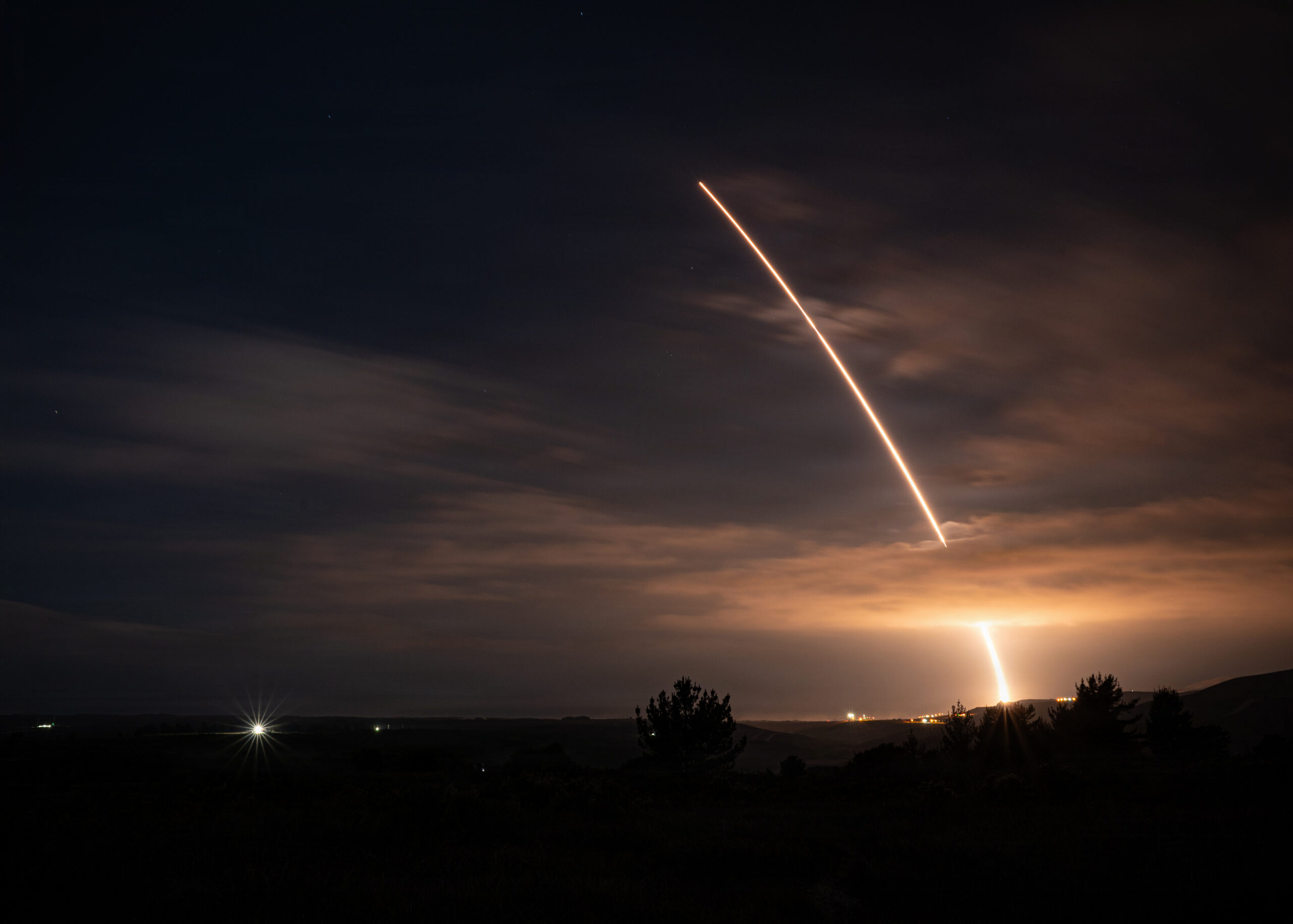
‘I made one great mistake in my life – when I signed the letter to President Roosevelt recommending that atom bombs be made; but there was some justification – the danger that the Germans would make them.’ – Albert Einstein in 1969, about a letter he wrote to the President in 1954.
The stalled US–Iran negotiations on Tehran’s nuclear program and President Donald Trump’s announcement of a US-Saudi nuclear agreement have put nuclear weapons back in the spotlight.
But the threat of nuclear breakout has been growing for several decades, driven by the same fear Einstein held in the 1940s. Today, the permanent five UN Security Council members – the United States, Russia, China, Britain and France – plus North Korea, India and Pakistan, have nuclear arsenals and sophisticated delivery systems. All are expanding or modernising their arsenals. Prior to Israeli and US attacks in 2025 and 2026, Iran was on track to obtain nuclear weapons. Tehran may still be on this track.
Increasingly, other countries are questioning US commitment to extended nuclear deterrence: using nuclear weapons to defend other countries. Some of these countries could be contemplating indigenous nuclear capabilities.
The last of the US-Russia nuclear arms limitations treaties, ‘New START’, expired with no replacement in February.
So, for the first time in six decades, the world has entered an era without nuclear weapons constraints. Yet today’s international community lacks the resolve and inventiveness of the early Cold War years when a global grand bargain was struck: the then five nuclear weapons states would pursue disarmament, and countries without nuclear weapons would agree not to develop them in exchange for access to peaceful nuclear technology.
How did we reach this moment?
Since the height of the Cold War, when the US and Russia held around 44,000 warheads each, the two powers led disarmament, arms limitation and non-proliferation efforts. The two powers and their allies built the global nuclear control architecture through regular reviews of the Nuclear Non-proliferation Treaty, adjacent agreements on testing and export controls placed on components, and expansion of the mandate of the United Nations’ nuclear watchdog, the International Atomic Energy Agency (IAEA).
All benefited from strategic stability, transparency and risk reduction practiced by the Permanent Five, and non-nuclear states’ access to peaceful nuclear technologies.
But the architecture is now under strain. The non-proliferation treaty, Comprehensive Nuclear-Test-Ban Treaty and IAEA are being weakened by blocking, dilution and fracturing efforts conducted from within by Russia, China and their proxies.
With New START gone, attention is turning to China’s rapidly expanding nuclear capability. Any successor arms control framework to New START must include China and account for next-generation technologies: artificial intelligence, proliferation-proof machinery and space-based systems.
The question more openly being asked by allies and non-aligned states is: can the nuclear weapons powers can be relied on to provide extended deterrence?
Moreover, does nuclear deterrence work in today’s strategic environment?
Russia’s war against Ukraine has shown that a smaller player can withstand threats – including nuclear coercion – using conventional weapons, smart technology and guerrilla tactics. Ukraine has struck deep into Russian territory, calling into question long-standing assumptions of the value of strategic depth. Similarly, Iran has exercised its leverage over the Strait of Hormuz and its ability to strike US regional bases and Israel, rendering debatable the question of whether it now actually needs a nuclear deterrent.
On the other hand, Ukraine, Libya and Iraq remain historic cautionary examples of what can follow when smaller states give up nuclear weapons or accept security guarantees that prove fragile. Each was attacked after removing nuclear assets from its territory.
North Korea watched and moved quickly to build its own nuclear weapons and long-range strike capabilities. Pyongyang is clearly aiming to join the P5, India and Pakistan in the small club of countries with .
In the early 2000s as Pyongyang ramped up its nuclear program, the Western consensus was that North Korea was developing long-range strategic nuclear capability to deter the US.
But in recent years, Pyongyang has also threatened Seoul with tactical nuclear strikes. Moscow did the same against a surprisingly resilient Kyiv in the first year of a war that quickly bogged down into a series of grinding, indecisive battles.
A live debate continues about how and whether such nuclear coercion is effective, or whether the constraining effect of mutually assured destruction will influence the US, Russia and China from embarking on a dangerous new era of nuclear expansion.
Analysis remains divided between those who believe the nuclear taboo remains cogent and those who do not. Meanwhile, a growing chorus worries that front-line states, such as South Korea, Japan, the Baltics, Poland and Saudi Arabia, could move to obtain the bomb and begin a cascade of nuclear breakout.
The strategic fear that prompted Einstein to advocate nuclear weapons in the 1950s, despite his later regret, is evident today.

How will the global nuclear order evolve?
US allies may be facing a significant new security dilemma. What role do nuclear weapons now play in deterrence? And if strategic nukes still do deter, will the US, China and Russia willingly create new nuclear guardrails even as they expand their arsenals?
Deterrence is a mind game. To deter an adversary may require only a small degree of credibility, but assuring an ally requires far more. The Cold War world believed in the constraints of mutually assured destruction because the US and Russia did not activate their strategic nuclear arsenals and catastrophe was avoided through luck and controls.
The most important control, then and now, remains the knowledge that nuclear strikes could bring catastrophic consequences for the aggressor.
For Australia, the prospect of South Korea, Japan or Indonesia seeking nuclear weapons would be game-changing. In particular, Seoul has deep expertise, advanced missiles, submarines and air power. With polling also indicating strong domestic support for acquiring nuclear weapons, it is under scrutiny by foreign-policy commentators.
Around 1,000 US nuclear weapons were removed from the Korean Peninsula in 1991. From that time on, Pyongyang reoriented its Soviet-era assets and is now believed to have enough weapons grade material and delivery systems for 70 warheads. In the past two years the regime has renewed its defence pact with Russia and gained Russian nuclear technology and tacit Chinese acceptance as a nuclear weapons power.
Yet in the face of credible threats from a highly capable Pyongyang, Seoul has not moved to obtain or build indigenous nuclear weapons. Under a 1972 agreement with the US, South Korea is prohibited from uranium enrichment and plutonium processing and is thus denied an essential ingredient for nuclear weapons. Washington has not altered that agreement and is unlikely to, for fear of being drawn into nuclear war with North Korea. If South Korea did not move to obtain nukes, Japan wouldn’t, either.
The Baltics and Poland are fully and materially committed to NATO, which provides credible layered conventional and nuclear deterrence for Europe.
The outlines of Saudi Arabia’s reported nuclear power technology deal with the US are not clear. Concerns that the Trump Administration would provide that technology without the IAEA Additional Protocol – a significant control originally developed by Australia, allowing for challenge inspections on sites not declared by the hosting country – are well founded. Such a Saudi–US deal would dilute an essential element of non-proliferation machinery in place for 144 IAEA member states, including the United Arab Emirates, India, Pakistan and Iran. Tehran continues to host IAEA inspectors to this day.
How committed is the US to the global machinery it built? Trump has long argued for eliminating nuclear weapons and has sought denuclearisation of North Korea and Iran as part of his legacy. But as current events starkly show, he may never progress those regarding Iran or North Korea. And he has little time left in power to work with Xi or Putin on any new arms limitation arrangement, even if either leader were inclined to make one. Russia is unlikely to be capable of developing next-generation AI-powered nuclear weapons and delivery systems. China and the US are at the apex of this game now.
There is good reason to worry. A theoretical debate about the deterrence value of nuclear weapons seems oblivious to nuclear weapons states being wedded to their growing arsenals, and technology is expanding and available through illicit weapons trading networks. And all but China are postured for or are actively fighting in warzones.
There is a positive story to tell. The US nuclear umbrella is in good shape with the B61-12 thermonuclear gravity bomb, refurbished European basing facilities and allied air power. Multi-layered deterrence using conventional and nuclear weapons is in place and operational.
Ultimately, however, only China and the US can build a new nuclear consensus. As Beijing moves towards strategic nuclear parity with the US and Russia, it may be more willing to discuss transparency and risk reduction. The US, for its part, must show it remains capable of shaping the nuclear rules and willing to use its military and political power to enforce them.
In this unstable era, assurance and guardrails are no longer optional. They are the minimum conditions for avoiding the next nuclear crisis.













Leave a comment