


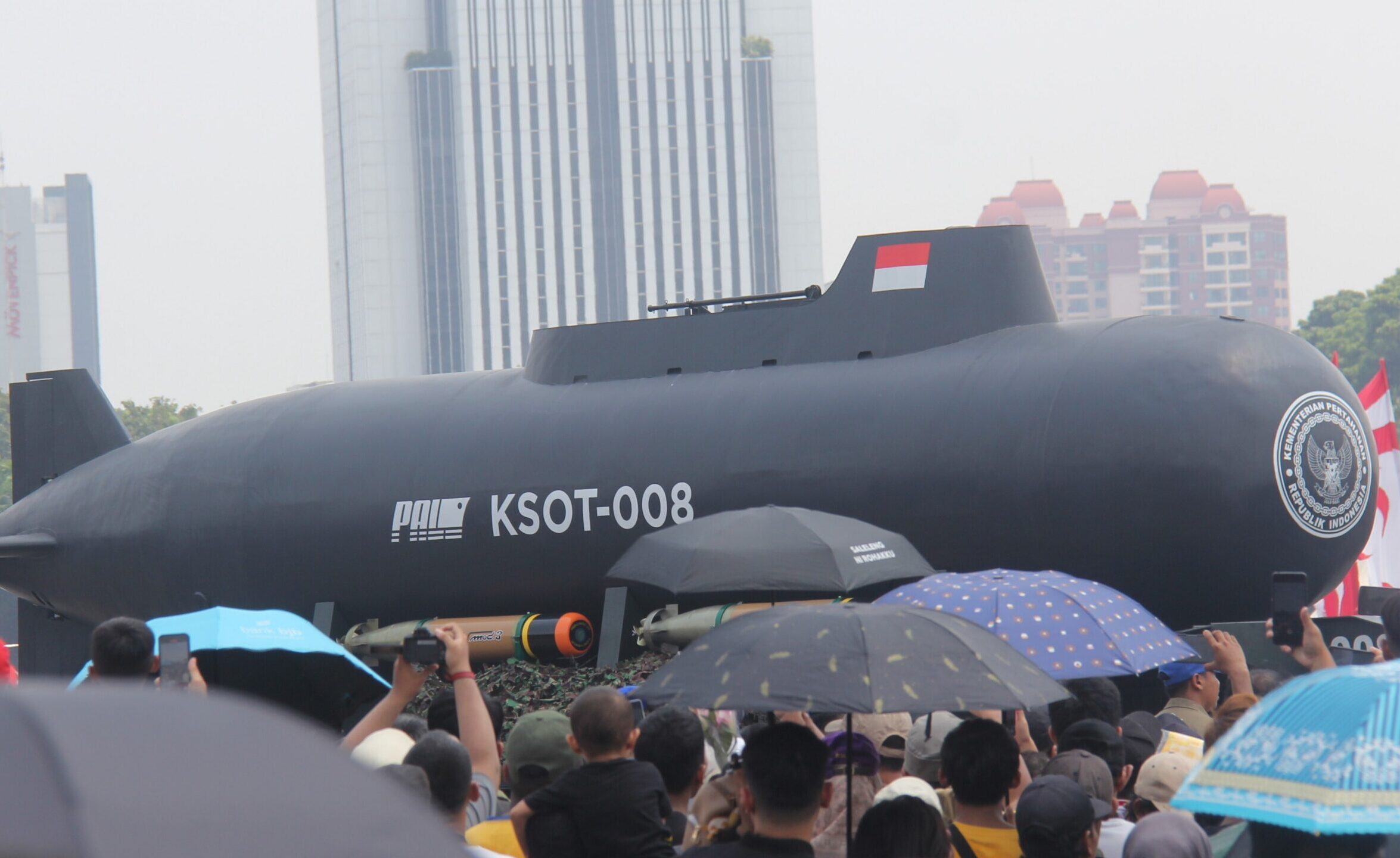
In February, an Indonesian naval officer publicly acknowledged what had long been understood in the service: foreign submarines routinely transited Indonesian waters, including through passages such as the Wetar Strait, often with little warning to Indonesian forces. The admission was the clearest statement to date of a challenge for Indonesian surveillance that has grown more acute as Indo-Pacific undersea activity has intensified.
Indonesia’s maritime jurisdiction covers some 6.4 million square km, an area crewed platforms alone can’t cover persistently. Recent acquisitions, including two Scorpene Evolved submarines, new multipurpose offshore patrol vessels and additional locally built frigates, expand the fleet but remain modest when compared with the area to be patrolled. At 337 trillion rupiah (A$26 billion), or 1.5 percent of GDP, Indonesia’s defence budget in 2026 was 37 percent higher than a year earlier. But fleet maintenance and readiness remain enduring constraints.
Closing the surveillance gap is a problem of persistence, endurance and coverage, not platform numbers alone.
It is against this backdrop that the navy’s renewed interest in uncrewed systems should be read. On 16 April, Indonesian Navy Chief of Staff Admiral Muhammad Ali said the service would intensify the use of aerial drones and other uncrewed systems for maritime patrols, including autonomous submarines specifically for underwater surveillance. Although the announcement was linked to fuel conservation, its strategic logic goes further. Ali had previously argued that securing Indonesia’s straits and coasts would require not simply more frigates but a larger number of smaller patrol vessels. Uncrewed systems fit with that thinking: they can extend surveillance coverage, remain on station for longer periods and do so with a smaller logistical footprint.
Foreign actors have already demonstrated the utility of uncrewed vessels for surveilling Indonesian waters. The repeated recovery of underwater objects along Archipelagic Sea Lane II, from a 2020 Sea Wing glider near Selayar to the three devices recovered in April this year pointed to a sustained effort to collect hydrographic, acoustic and seabed data by uncrewed means. If others have judged these waters worth surveilling persistently through autonomous platforms, the case for Indonesia adopting the same approach is well demonstrated.
Indonesia won’t be starting from scratch in this endeavour. The navy already operates several uncrewed aircraft, including the Boeing Insitu ScanEagles donated by the United States and HC-540s from China. The navy also demonstrated its capabilities in conducting shipborne uncrewed-aircraft operations during Latopslatgab, its Joint Naval Operation Exercise, in April. In May 2026, a Turkish Aerospace Industries delegation inspected Tanjungpinang Naval Air Station for hangars intended for Anka-S drones, indicating their likely operational deployment.
In contrast, efforts at applying uncrewed systems on and below the sea surface are less mature. Kapal Selam Otonom, an autonomous submarine designed by Indonesian state-owned shipbuilder PT PAL, remains at prototype stage, despite successfully firing a torpedo for the first time in waters off Surabaya in October 2025. The Indonesian Defence Ministry’s target of producing up to 30 boats of the class for deployment along critical straits does not look close to achievement. The navy’s surface drone programs are also exploratory, with the most visible efforts seemingly focused on modifying jet skis into remotely controlled vessels.
While the gap is recognised institutionally, execution has been slow. In 2025, Ali confirmed that the navy had requested funding for a fixed undersea surveillance system, and undersea sensing has long been listed by the Defence Industry Policy Committee among the top 10 national defence industry priority technologies. Progress remains exploratory, and the navy continues to draw on cooperation with Singapore’s Information Fusion Centre for maritime domain awareness as a partial stopgap. This slow pace strengthens the argument for mobile uncrewed sensors that can be fielded incrementally and redeployed as priorities shift.
The harder task is not simply acquiring or building the uncrewed aircraft and vessels but integrating them into Indonesia’s maritime surveillance architecture. Indonesia’s existing maritime surveillance backbone, the Integrated Maritime Surveillance System, comprises coastal surveillance stations, ship-based radars and regional command centres operated by the navy. A parallel 167 million euro (A$274 million) National Maritime Security System, launched in 2025 for Indonesia’s Maritime Security Agency, will add command centres, coastal surveillance towers, long-range drones and integration with patrol vessels.
For uncrewed sensors to be more than impressive but isolated assets, they must feed into these networks and into the navy’s Integrated Fleet Weapon System, which knits together units of the fleet, supported by reliable datalinks, secure communications, common operating pictures, doctrine, training, maintenance systems and clear rules of engagement. That will be difficult given delayed availability of satellite communications, a diverse inventory of aircraft and ships, and shortages of trained operators.
The maritime surveillance environment around Indonesia is changing. The contest below the surface is no longer hypothetical, and the gap admitted by the navy will not be closed by crewed platforms alone. The question is how to weave uncrewed systems into a navy, and a wider maritime security architecture, that moves in sync.














Leave a comment