


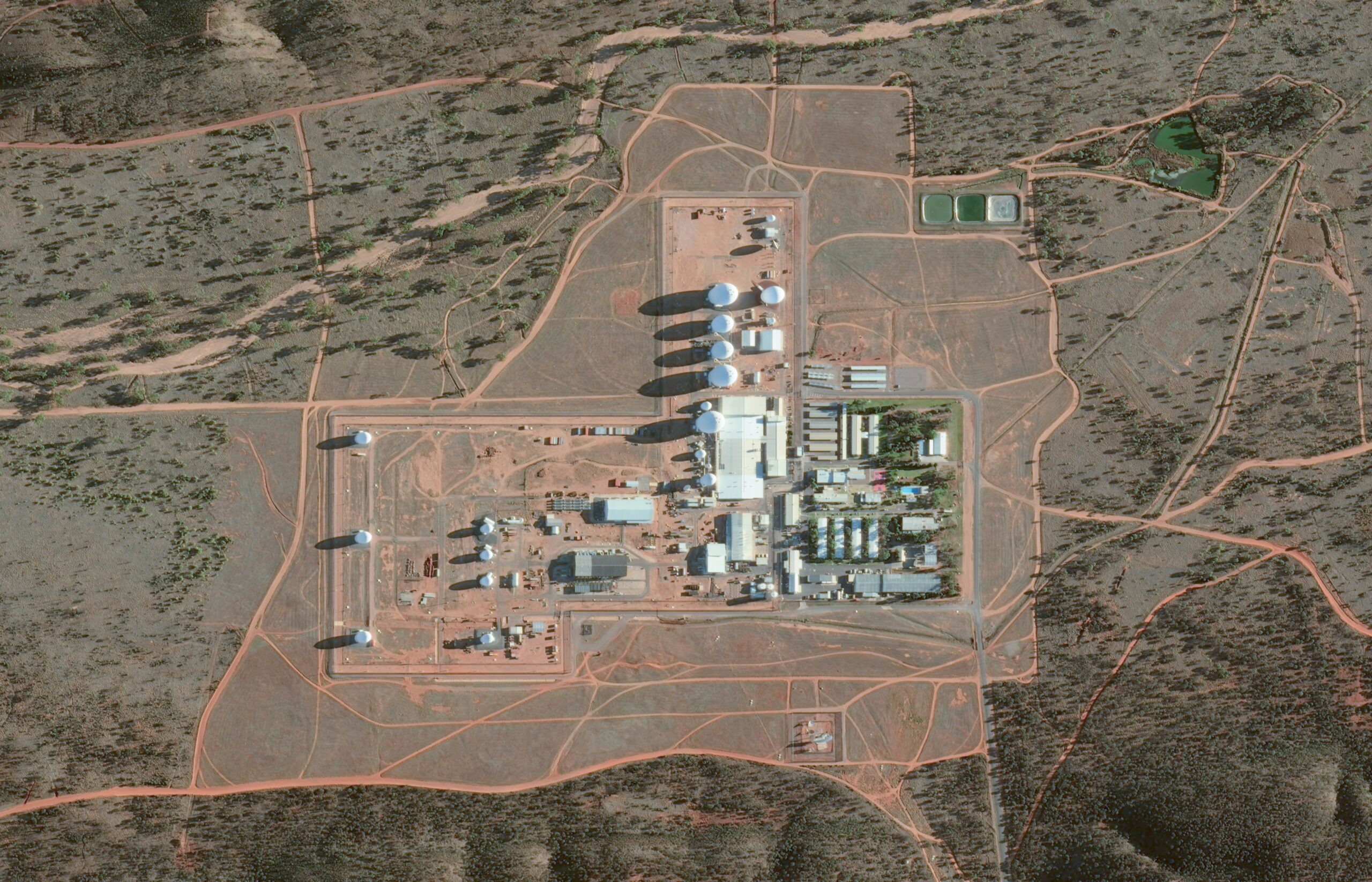
Australia is probably overestimating Pine Gap’s support for our place in the US alliance. It’s no longer irreplaceable.
The reasons the joint US–Australian intelligence facility sits in the central desert rather than on a Pacific island are quietly disappearing. That should worry us, because Pine Gap has long been one of our most valuable contributions to our closest intelligence partnership.
Start with why the location near Alice Springs was chosen in the first place. The facility is a ground station for US satellites that listen from high orbit. Those satellites collect faint signals from far inside other countries – including from missile tests, radar sites and military communications – and beam what they gather back down to earth. That downlink must land somewhere. Where it lands matters a great deal.
Central Australia was close to perfect when the US and Australia agreed in 1966 on its establishment. The signal down from the satellites was hard to steal. Anyone trying to catch it would have to be physically nearby, and in the middle of the Australian desert there was nowhere to hide. If the same station were on an island such as Guam or Diego Garcia, a passing ship could sit offshore and intercept the same feed. The desert kept prying eyes away. It was hard to photograph, hard to watch and hard to reach.
Pine Gap wasn’t just convenient. It was uniquely secure. That security was the point.
Now look at what has changed.
Encryption has moved on. As David Rosenberg outlined in his book Inside Pine Gap, the downlink used to be encoded but unencrypted, which allowed for greater throughput at the time. Now, the downlink no longer has to travel in the clear, so the old fear of someone catching an unprotected signal carries far less weight. Modern processing and encryption can protect that feed almost anywhere. The desert’s first great advantage has faded.
Watching the site is now easy. Commercial satellites take sharp pictures of anywhere on earth, many times a day. Anyone with a modest budget can buy detailed imagery of Pine Gap whenever they like. The remoteness that once hid the site from view no longer hides much at all.
The secret is out, too. When Pine Gap was built, its very purpose was closely held. Today the facility is widely described by researchers. There is far less to protect by keeping it in a quiet spot in the middle of the continent.
Add these together and the conclusion is uncomfortable. The United States could now run Pine Gap’s missions from somewhere else. A relocated operating base wouldn’t be perfect, nor would establishing it be costless. But the enormous head start that central Australia once offered has shrunk. Where Pine Gap was once the crown jewel of our contributions, it is starting to look like one gem among many.
This is where Australia needs to pay attention.
Pine Gap has given us something we likely couldn’t have built alone. We have shared in intelligence and expertise far beyond anything our own resources could produce. We have no satellites of this kind. We have no way to launch them, because we have no heavy rockets to put big satellites into high orbit. Matching the US effort from our own industry would be impossible at anything close to the scale required. The facility has been a way of buying into a system we would otherwise struggle to build.
If the reasons to keep that system in Australia are weakening, then the leverage we have long drawn from hosting it weakens too. That doesn’t mean the Americans are about to pack up and leave. The relationship is deep, and moving a station like this is hard, slow and expensive. But strategy is built around trends, not just today’s balance. And the trend is running against the idea that Pine Gap is irreplaceable.
There is a second shift worth naming. The rise of cyber collection capabilities has changed what these overhead satellites are for. A great deal of what once had to be plucked from the air can now be reached through networks and cables instead. Overhead is no longer the only way in. Its role is narrowing.
But narrowing is not the same as ending. Some tasks still can’t be done any other way. The clearest is watching foreign missile tests. When another country flight-tests a missile, it broadcasts a stream of technical data about how the weapon performs. Catching that stream from orbit is one of the few ways to learn what a rival’s missiles can really do.
The comfortable story that Pine Gap makes us indispensable is getting old. The desert that once made the facility priceless is no longer the fortress it was, and the intelligence world has moved on around it.
Pine Gap still matters. But the question for Canberra is whether the facility still matters as much to us as we assume, and what we should do about it.














Leave a comment