


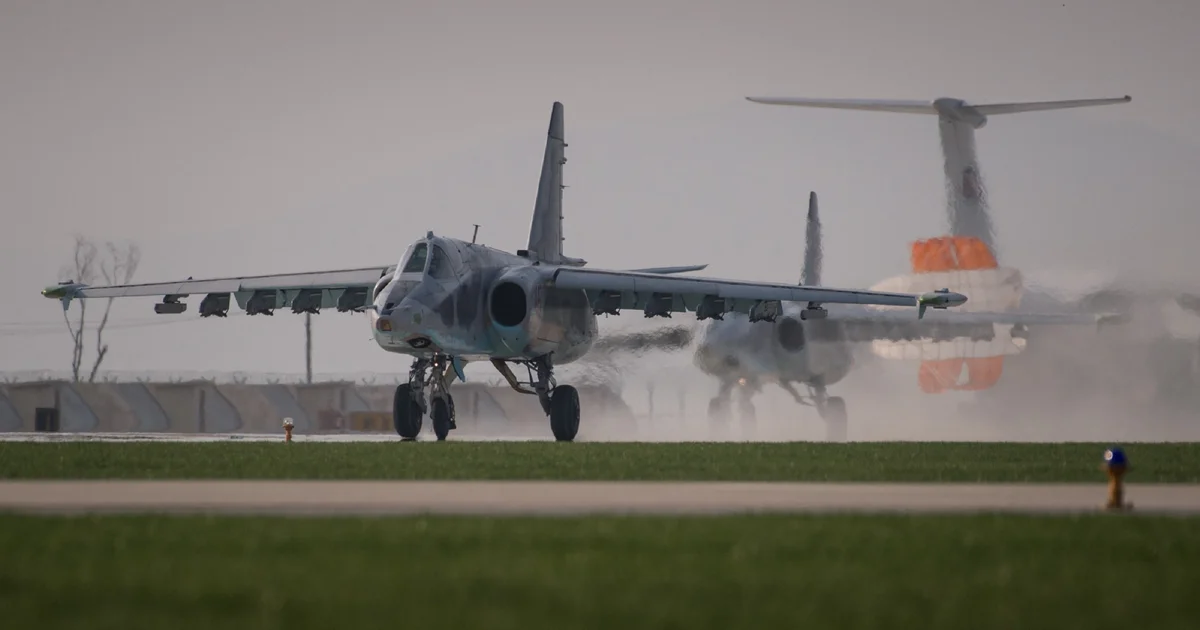
North Korea’s air force has a current focus (Opens in new window) on ground-based homeland defence. Pyongyang is expected to use its An-2s to transport (Opens in new window) commandos behind South Korea’s lines because these planes can fly low enough to evade radar – while early warning and control aircraft are intended to detect incoming attacks and give updates on enemy locations. Jet fighters are to defend (Opens in new window) North Korean ground-based assets from airborne attacks while medium-range bombers preemptively attack (Opens in new window) the enemy’s logistic hubs and military bases.
Kim has demanded (Opens in new window) that the air force must extend its operation beyond North Korea’s airspace, territory, and waters and be ready for “grand transformative battle zones”. This signals a shift in air force doctrine, from homeland defence to power projection, as Kim had previously identified (Opens in new window) South Korea, Japan, and Guam as targets (Opens in new window) under his nuclear strategy. As one leg of the triad, North Korean air force is expected to attack these targets with nuclear bombs or cruise missiles.
However, the operational ranges of North Korea’s most capable aircraft – Ilyushin IL-28 bombers (Opens in new window), MiG-29s (Opens in new window), and Su-25s (Opens in new window) – are 2,180, 1,430, and 1,000 kilometres respectively. IL-28 bombers can reach US bases in Okinawa, located 1,400 kilometres away, but they would be without fighter escorts. North Korean aircraft cannot attack US bases in Guam, which are 3,400 kilometres away. For targets (Opens in new window) closer to home such as Daegu, Tokyo, or Sasebo, these Cold War-era bombers and fighters lack to evade the US-South Korea-Japan .
To elevate the air force to a nuclear deterrent, North Korea must extend the range of fighters and bombers by acquiring aerial refuelling tankers or aircraft carriers, which North Korea lacks and are (Opens in new window) expensive (Opens in new window) to procure and maintain. North Korea would also have to invest in stealth technology (Opens in new window) for its bombers and fighters to penetrate, survive, and retreat from enemy airspace and the vastness of the Pacific Ocean. Its fighters will have to be brought closer to fifth-generation capabilities (Opens in new window) to the likes of Su-57s to escort bombers.
Keeping aircraft safe while not flying is another problem. North Korea has built more runways to ensure survivability by redundancy, but a runway is still an easier target than a missile launcher. Even in the unlikely scenario that North Korea can upgrade its air force and procure enough fighters and bombers, directing its air force away from homeland defence means North Korea is leaving its ground-based assets vulnerable (Opens in new window) to airborne attacks.
Given the operational vulnerabilities of the air force as a nuclear deterrent, Kim may instead want to use nuclear-capable aircraft as a signalling tool. Unlike ballistic missiles concealed in silos or submarines lurking underwater, bombers flying over North Korea’s territory can signal a willingness to escalate to the nuclear threshold to deter (Opens in new window) its enemies from striking first. Primitive bombers carrying nuclear bombs or fighters armed with nuclear-capable air-launched cruise missiles are enough for this purpose. North Korea having its own nuclear bombers would offset the image of the US flying (Opens in new window) nuclear-capable bombers over South Korea. Pyongyang doesn’t need them to survive because the backbone (Opens in new window) of the nuclear deterrent is still the ground-based ballistic missiles. If the United States and its allies shoot these aircraft down over North Korea’s sky, they will bear the onus of starting the war.
There is also prestige in acquiring a nuclear triad. Only the United States, Russia, China, and India have achieved this milestone. Kim’s nuclear-capable air force would supersede his grandfather and father’s legacy just as he has done (Opens in new window) with his Choe Hyon-class destroyers.















Leave a comment