


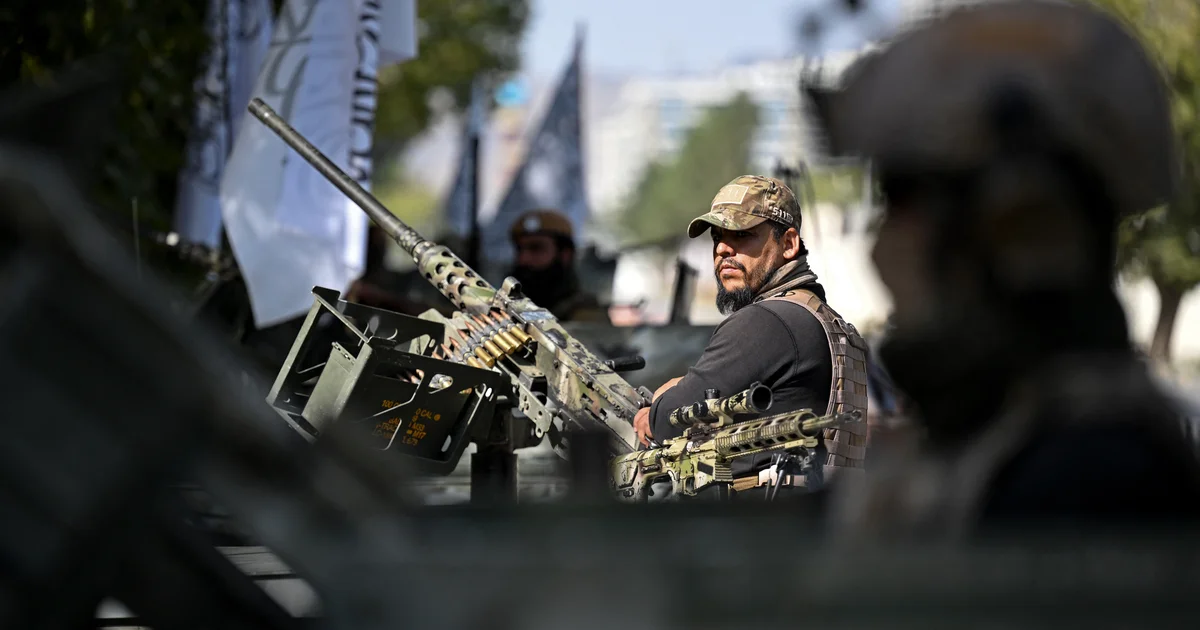
The National Resistance Front of Ahmad Massoud, son of the famous anti-Soviet commander Ahmad Shah Massoud, is the best-known armed opposition movement and draws heavily on the political symbolism and networks of the old Northern Alliance. The NRF regularly claims (Opens in new window) attacks across northern Afghanistan and Kabul. It operates apart from the AFF.
Then there is Sami Sadat, the cigar-smoking former commander of Afghanistan’s special forces, who leads the Afghanistan United Front from exile. Sadat presents himself as a national leader-in-waiting, promising (Opens in new window) to “take back Afghanistan” and restore constitutional government. His organisation advertises political, civil and military wings, and a leadership drawn from former generals, intelligence officers and politicians. It does not provide a bridge between the disparate armed fronts.
A plethora of smaller groups are popping up under different banners across the country. Some appear to be little more than a handful of armed men under local command; others possibly tribal networks spanning several provinces. Claims of attacks stretch from Badakhshan and Takhar in the north, through Kabul and into the Pashtun south.
Numbers and geographic proliferation should not be misconstrued as military strength or cohesion. Small, scattered attacks might expose weaknesses in Taliban control but they also tell the Taliban where their weaknesses lie, allowing the regime to reinforce local security and identify threats before they become serious.
There is no obvious external patron capable of uniting these groups into a cohesive anti-Taliban fighting force. The anti-Soviet mujahideen, by comparison, had Pakistan, the United States, Saudi Arabia and others supplying money and weapons.
Today’s anti-Taliban groups have sympathisers abroad and might find new opportunities as relations between the Taliban and their former patrons in Islamabad continue to deteriorate. So far there is no apparent pipeline of sustained foreign military or financial support.
This could change, as could the military balance. But an influx of money and weapons would immediately raise the question: Who gets them?
The men leading Afghanistan’s resistance fronts are not just military commanders; they are prospective political leaders, with their own ideas about how the country should be ruled, and by whom.
Five years of exile have not produced a credible, unified political opposition.
Afghanistan has seen this movie before. The Taliban emerged from a protracted civil war fought by powerful men, each convinced he should lead the country. In Kabul alone, an estimated 25,000 (Opens in new window)people were killed as rival warlords fired rockets and artillery across frontlines sometimes separated by the width of a street.
Today’s armed groups lack the firepower and the manpower of the strongmen of the 1990s, many of whom are living in Europe or the United States with retinues and dreams of a triumphal return.
For now, the divisions among the Taliban’s enemies are helping protect the regime. If that changes, Afghanistan’s resistance fronts might find that overthrowing their common enemy was only the beginning. The hardest part might be deciding who among them should inherit the state.








Leave a comment