


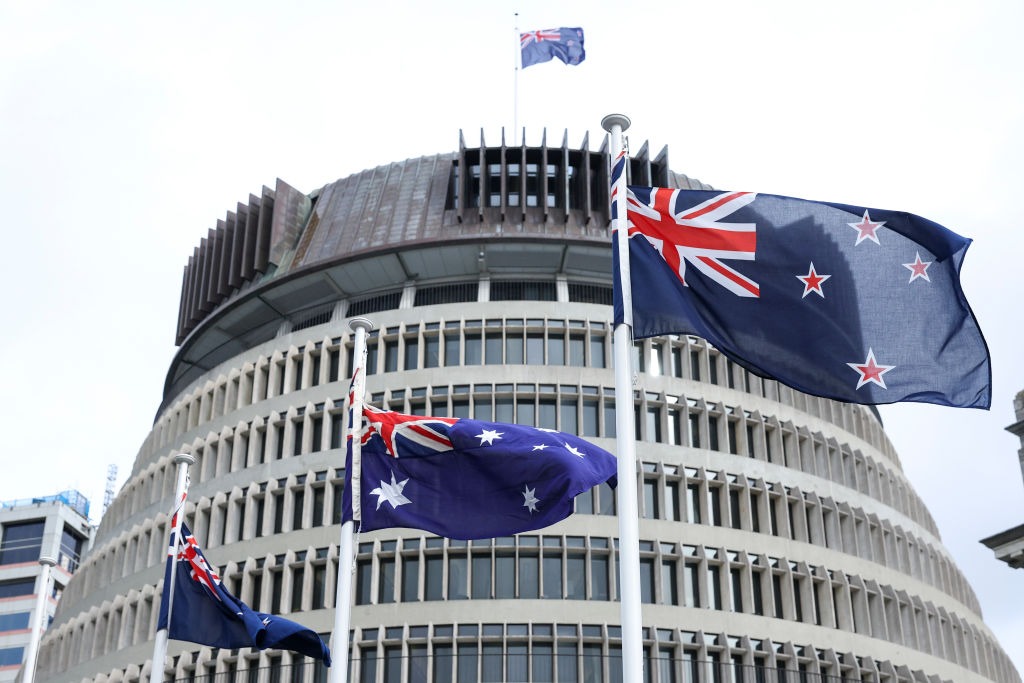
Let’s not overlook the Kiwis as we mark 75 years since the signing of the security treaty between Australia, New Zealand and the United States (ANZUS) in San Francisco on 1 September 1951. After decades in the shadows, ANZUS is back in the foreground of cross-Tasman relations. Its importance will grow as Canberra and Wellington deepen military cooperation and further their security support to Pacific countries, seeking to deter China.
For the last 40 years, ANZUS has been a shorthand for the bilateral alliance between Australia and the US. This was because Washington suspended its treaty obligations to New Zealand in 1986 after Wellington refused to host US nuclear-powered or nuclear-armed vessels.
Although ANZUS never lapsed between Australia and New Zealand, in recent decades, Wellington has preferred to downplay the treaty and talk up bilateral arrangements, such as the 1944 Canberra Pact and the Closer Defence Relations initiative that began in 1991. Meanwhile, both sides have championed a history of mateship dating back to Gallipoli and the formation of the Australian and New Zealand Army Corps (ANZAC) in World War I.
But times have changed. New Zealand’s current prime minister, Christopher Luxon, has helped reinstate ANZUS as the centrepiece of the trans-Tasman alliance. Working with Canberra, the Luxon government established coordination mechanisms that it’s surprising were not in place already, such as an annual meeting of Australian and New Zealand foreign and defence ministers (ANZMIN), which first met in February 2024. By comparison, the Australia–US equivalent, AUSMIN, has convened nearly every year since 1985. Every ANZMIN joint statement has referred to ANZUS.
Building on ANZMIN, Prime Minister Anthony Albanese and Luxon held the inaugural Australia–New Zealand leaders’ meeting in August 2024. This annual fixture produces substantial joint statements about the direction of the alliance. By replacing the somewhat ad hoc manner of past meetings between prime ministers, it signals that the relationship is strategic as well as cordial.
In their first joint statement, Luxon and Albanese clarified that a cyberattack against either country could meet the threshold for a collective response under article 4 of ANZUS. In subsequent meetings, they have consistently promoted the Australia-New Zealand alliance, rooted in ANZUS, as critical for regional security.
The alignment of strategic outlooks across the Tasman reflects growing distrust of China in both countries, which shows up in opinion polls, policies and political rhetoric. Canberra and Wellington share intelligence on Beijing’s intentions and tradecraft, which has informed tougher counter-interference measures in both countries. Arguably, Wellington’s agencies are now more forthright than their Australian counterparts in pointing the finger directly at China’s espionage, as the New Zealand Security Intelligence Service’s threat assessment, published on 13 August, showed.
Canberra and Wellington also agree on the need to increase defence investment and cooperation. The public case for this was boosted by the Chinese navy’s circumnavigation of Australia last year, which included a live-fire exercise in the Tasman Sea. Beijing bolstered the case again by surprising Pacific countries with its test of a nuclear-capable submarine-launched ballistic missile in July this year. In such strategic circumstances, there are grounds for hope that the increases in defence spending laid out in New Zealand’s 2025 Defence Capability Plan will survive the general election in November this year.
A key decision for New Zealand’s next government will be whether its navy acquires a Japanese or British frigate. If New Zealand selects the Upgraded Mogami-class frigate from Japan that Australia is getting, it could unlock economies of scale, facilitate joint sustainment and support interoperability, as has been the case with the current class of ANZAC frigates that both navies are scheduling for retirement. This seems the ideal way to galvanise the bilateral vision for ANZAC 2035, the latest iteration of the Closer Defence Relations initiative.
New Zealand can also leverage its alliance with Australia to broaden its international networks. For instance, selecting Mogami would enable trilateral cooperation with Japan. Defence ministers from Australia, New Zealand and Japan met on the margins of the Shangri La Dialogue in May, although plans for a follow-up trilateral in Canberra in August were scuppered by domestic factors in Wellington.
Luxon has long been enthusiastic about small-group formats such as the Indo-Pacific Four, which also includes Australia, Japan and South Korea. But a more important development is his announcement that New Zealand will engage Australia and Fiji about potentially joining the Ocean of Peace alliance announced in July, which is a mutual defence treaty. At ANZMIN this year, ministers also welcomed the formalisation of Australia’s alliance with Papua New Guinea in the 2025 Pukpuk Treaty, although there’s no hint yet that Wellington is seeking to join that.
Over time, the Australia–New Zealand branch of ANZUS could develop into a regional defence pact that includes some other Pacific countries but not the US. That would be an opportunity for Canberra, Wellington and other US partners to encourage Washington to look again at its ageing hub-and-spoke alliance system in the Indo-Pacific, which ANZUS is part of, potentially revamping it into a collective defence pact. That seems a pipedream while New Zealand clings to its antinuclear policies, but as the strategic horizon darkens, even those may not be set in stone.












Leave a comment