


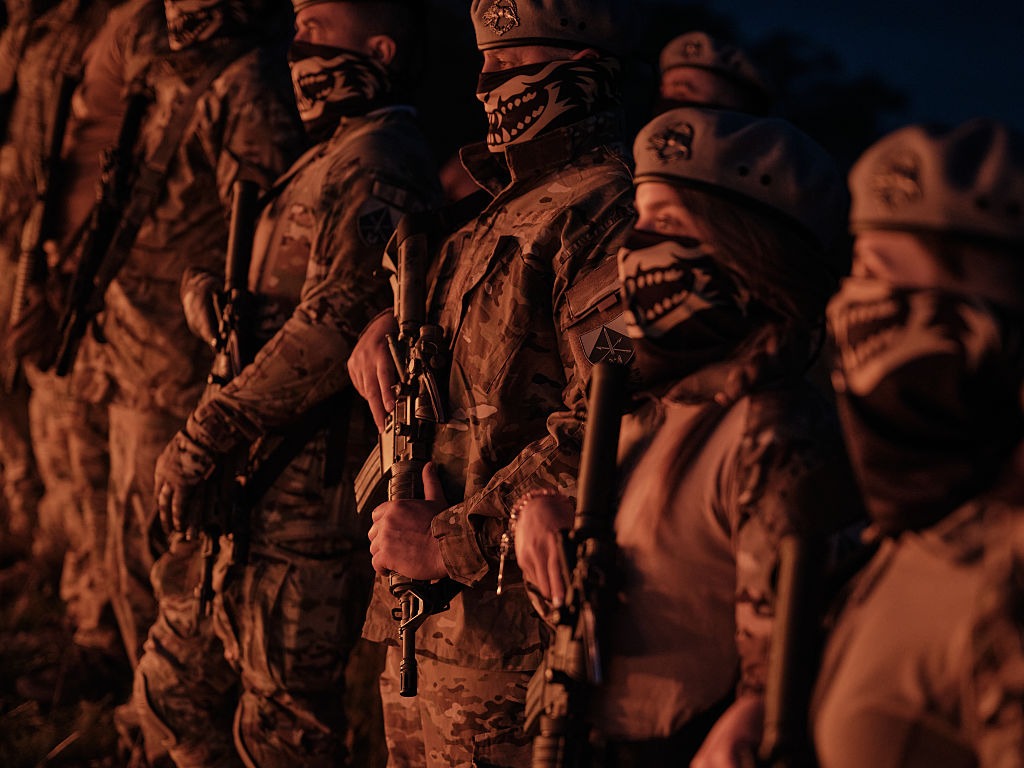
Throughout the Russia–Ukraine war, special operations forces (SOF, or SSO in Ukrainian) have conducted many raids and missions to probe enemy defensive positions. Examples include Ukraine’s use of SOF probing operations in Bryansk and Kursk in 2023 and 2024 before launching its incursion into Russia’s Kursk region in August 2024.
At the same time, the drone war in Ukraine was rapidly accelerating. By 2025, Kyiv had established a drone wall, with virtually every part of the front monitored by uncrewed aircraft. Conducting manoeuvre warfare became increasingly difficult, and snipers and special forces operators also faced greater risks.
‘Xen’, a former US special forces operator who has worked with a Ukrainian special forces regiment, told me that in 2020, he had worked with a US SOF unit training Ukrainian special forces and that the instruction had been largely one-directional. Drone warfare had not changed battlefield doctrine, and the Ukrainian trainees were learning extensively from the Americans.
By the time the full-scale invasion started, drone usage throughout 2022 was limited, but quickly growing, especially for situational awareness. ‘Heavy casualties early in the war also erased a significant amount of institutional knowledge,’ said Xen. ‘Some lessons we had taught simply didn’t persist.’
However, when he returned to Ukraine in early 2024, the situation had changed dramatically. ‘Major gaps remained in what I would call meta-competencies: mission planning, discipline, SOP [standard operating procedures] adherence, after-action reporting, and institutional learning loops,’ said Xen. ‘But regardless, Ukrainians had by then become world leaders in drone warfare.’
Various US SOF operators that I spoke with, on and off the record, who came to fight in Ukraine in 2022, worked as snipers. In recent years, however, their roles have shifted away from sniping because of the danger posed by drones. Since drones constantly monitor the front, the location of a sniper who has become active is now much easier to identify. Drones or artillery can then eliminate them. In effect, drones have become the new snipers.
‘Every single SOF sniper I trained is now a drone pilot of one type or another,’ said Xen. ‘The small independent teams who defined themselves as hunters who could hit the enemy with relative impunity from 1 to 2 km now do so from a range of 30 to 300 km.’
In places such as the battle for Pokrovsk, many commentators expected the city would fall in 2024, but the battle dragged on for much longer. According to Bryan Pickens, a former US Green Beret who has fought in Ukraine, Pokrovsk held out for so long due to SOF being utilised as intended in the city, ‘as a way to multiply military power on the front line.’
Pickens noted that Ukraine’s 3rd Separate Special Purpose Regiment, for example, would deploy three teams to sectors facing a Russian offensive. One team reinforced frontline infantry by training soldiers and building drone capabilities, another stayed in reserve, while the third conducted drone operations against Russian positions.
The concept mirrored unconventional warfare techniques taught by US Green Berets. Instead of fighting alone, Ukrainian special forces trained and equipped conventional infantry as a partner force before Russian assaults. ‘Pokrovsk was defended for two years longer than it was expected to fall due to this SOF effort and unconventional warfare techniques,’ said Pickens.
However, at times, drones can enable SOF field operations. For example, if soldiers in ghillie suits need to advance deeper behind enemy lines, and a mission is going successfully but they are running low on ammunition, they can sustain the fight by being resupplied with heavy bomber-drones. Drone detection and surveillance mean soldiers have very narrow windows to move in the open before being targeted by numerous drone drops.
As a result, they need to carry less weight and be able to move quickly. ‘Some Ukrainian assault regiments and SSO battalions have adapted by employing heavy bomber drones in direct support of small infantry or SSO teams,’ said Rob Lee, senior fellow at the Foreign Policy Research Institute, a think tank in Philadelphia.
Now, when assaulting trenches, SOF teams require a drone to be overhead at all times, watching from above and ensuring the area is clear before they advance. Once Russian soldiers infiltrate a Ukrainian position in a village or urban environment, they are often poorly equipped, and often scavenge for food and supplies, while relying on drones for resupply. But over time, if enough Russian soldiers build up in a position, they can carry out further attacks. So neutralising these infiltrators may require SOF teams to move in, but doing so exposes them to enemy drones, which remain the primary threat.
‘Obi’, a special forces operator from New Zealand who has been fighting in Ukraine since 2022 and joined the 3rd Separate Special Purpose Regiment in 2025, said, ‘The wars in Iraq and Afghanistan were fundamentally different. Many of the core principles from those conflicts remain useful, but the tactics often don’t translate well to the kind of large-scale conventional warfare being fought in Ukraine.’
And that the Ukrainians have spent years learning to adapt under the demands of the battlefield.
‘They have developed entirely new approaches to many aspects of warfare and have tailored them specifically for modern, high-intensity combined-arms combat,’ said Obi. ‘That experience is what makes them unique today.’
So, the war in Ukraine has demonstrated that the role of SOF operators has stayed the same, but their application has changed with drones. ‘The ability to adapt and innovate not just the technology but also the military doctrine in place to employ that technology is how SOF elements stand to be effective in this war and in the foreseeable future of war anywhere in the world,’ said Pickens.
For elite units, drones allow them to become a force multiplier in neutralising the enemy, as Ukrainian special forces are also conducting mid-range strikes. That adaptation – and the ability to integrate new technology into doctrine – is a lesson that SOF operators around the world should take note of.











Leave a comment