


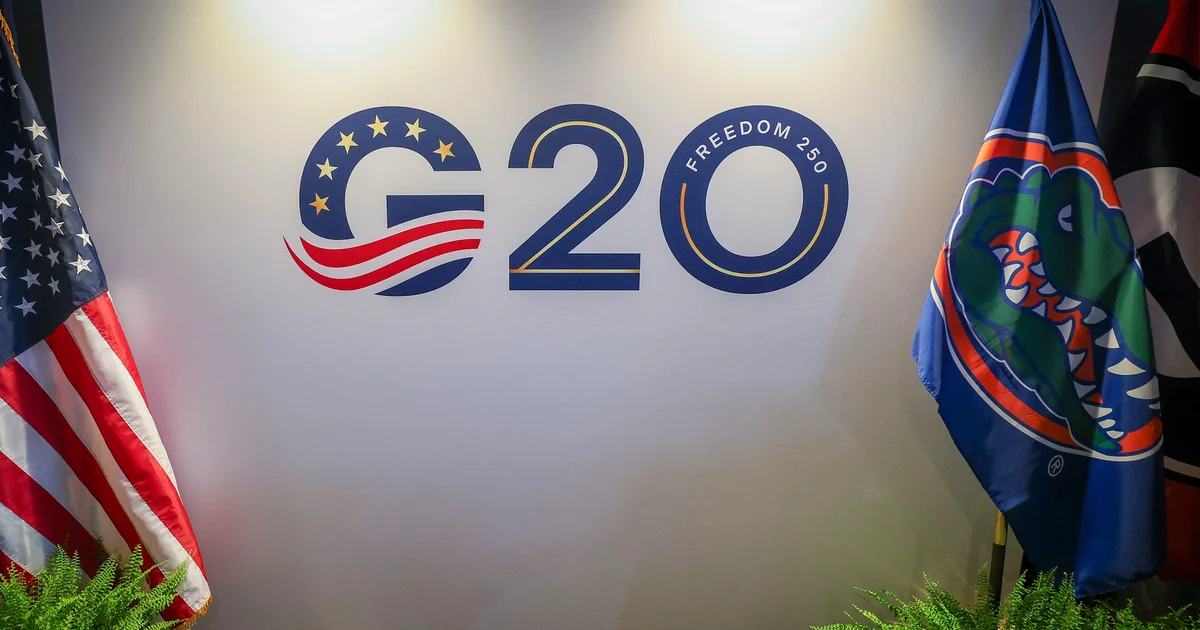
Similarly, at the G20 Trade Ministerial (Opens in new window) in Milwaukee, Wisconsin, members agreed on condemning the weaponisation of food through coercive trade measures. They did not, however, reach consensus on the proposed statement on forced labour in supply chains, while a US-backed proposal on structural excess capacity also failed to secure agreement. Ministers also expressed differing views on reforming the Most-Favoured-Nation principle.
These disagreements show that narrowing the range of issues under discussion does not remove the underlying conflicts that constrain collective action, and that fewer priorities do not necessarily produce greater consensus.
Besides the narrowing of the agenda, the way President Donald Trump’s administration has pursued this reorientation raises a different set of concerns. The starkest example has been the exclusion of South Africa from the 2026 proceedings. In November 2025, Trump announced (Opens in new window) that South Africa would not be invited to participate in the US-hosted G20 meetings, citing what he described as the South African government’s mistreatment of white Afrikaners and its alleged human rights violations.
Trump also objected to South Africa’s handover of the G20 presidency following the Johannesburg summit, which the US had boycotted. South African President Cyril Ramaphosa subsequently reaffirmed (Opens in new window) that South Africa remained a founding member of the forum and intended to continue participating as a full member.
While a presidency can propose fewer priorities and seek agreement on issues that deserve collective attention, excluding a member is a different exercise. It creates a tension between the US objective of making the G20 more focused and the principle of inclusive cooperation that lies at the heart of the forum. Moreover, its implications extend to the G20’s institutional continuity. Under the established troika arrangement, the previous, current, and incoming presidencies work together to maintain continuity across successive years. Dispensing with the troika by excluding the previous host risks making the G20 more dependent on the preferences of the incumbent presidency.
Trump’s unilateralism vis-a-vis the G20 can be understood in the context of his broader approach to multilateralism. Since returning to office for a second term, he has withdrawn the US from several international institutions and agreements, including the World Health Organisation, and in January 2026 directed its withdrawal (Opens in new window) from 66 international organisations and bodies.
As analysts have noted (Opens in new window), Trump’s approach combines withdrawal and disruption with selective engagement in institutions that serve his administration’s priorities. The G20 perfectly illustrates this pattern. One of the core missions stated on the home page (Opens in new window) of the official G20 presidency website is “strengthening partnerships that benefit American workers, businesses, and allies.” While seeking national benefits from its G20 presidency is not wrong, what stands out is the explicit positioning of those benefits as the core purpose of hosting a forum whose legitimacy rests on cooperation among its members.
The Miami Leaders’ Summit on 14-15 December will provide a final opportunity to assess the US presidency, but the record over the preceding 11 months already offers grounds for a preliminary judgement. The case for a leaner G20 remains defensible. But efficiency is not an end in itself. There is a distinction between narrowing the G20’s priorities through collective deliberation, and reshaping the forum through unilateral decisions. A more focused agenda can strengthen the G20 – only if it preserves the participation, consultation, and continuity necessary for collective action.










Leave a comment