


Governments planning around a rule set that moves will look for partners they can rely on, and reliability is what the Australian relationship supplies. By contrast, American policy on exporting AI components, has proved changeable. The diffusion rule that placed India in a capped tier was scrapped (Opens in new window) in May 2025 before it took effect, and a Commerce Department draft that would have required case-by-case approval for almost every advanced accelerator leaving the country was circulated in February 2026 and shelved a month later (Opens in new window). India’s access today is good, though it rests on a position that has already been reversed once and redrafted twice.
The most valuable early project for Australia and India would cost comparatively little. AI models are still evaluated overwhelmingly in English, so a model that performs respectably in English can fail badly in Hindi, Tamil or Bengali without the standard test suites registering it. India has 22 official languages and a government pushing AI into public services delivered in all of them, which gives it both the problem and the data. Australia has a new AI safety institute, a seat in the international network of such institutes, and no equivalent test set of its own. Shared benchmarks for multilingual and Indic-language models would be technically achievable and useful to both governments, and no commercial developer has much reason to fund them.
Both countries also have a similar approach to regulation – favouring guidelines over hard law. Both governments looked hard at binding AI rules, and both drew back within the same 12 months, India declining a standalone AI law in favour of the governance guidelines (Opens in new window) it published in November 2025, and Australia changing its proposed mandatory guardrails when the National AI Plan appeared. Each now runs a safety institute that tests and advises without holding regulatory powers.
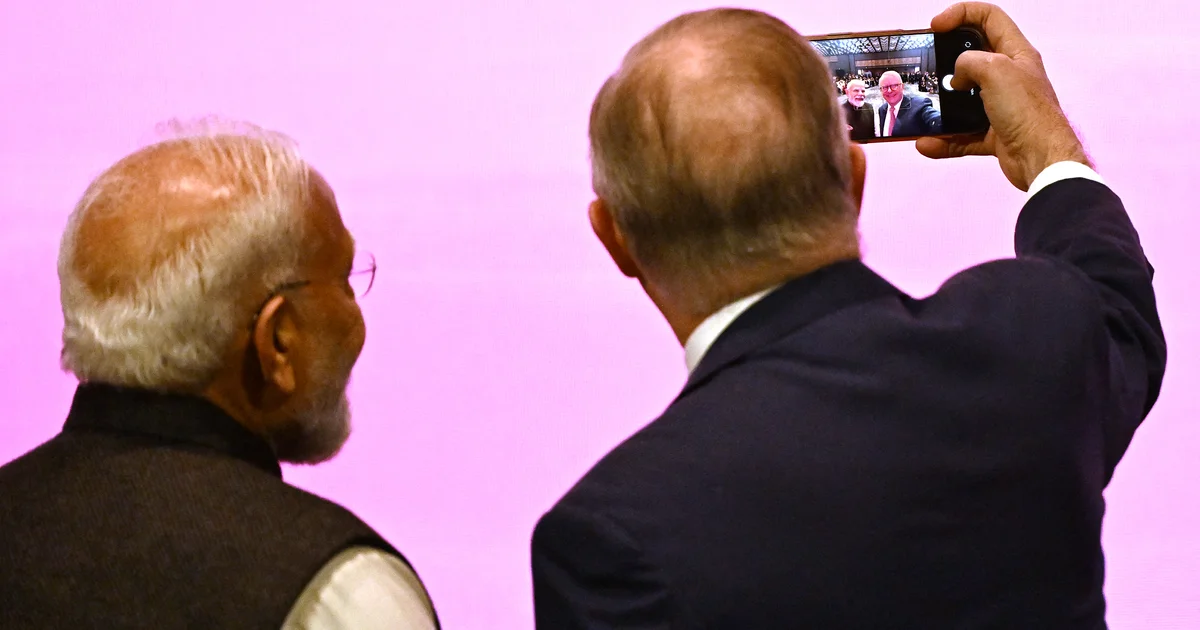
What the relationship lacks is machinery. The meeting between Modi and Australia’s Anthony Albanese in July 2026 launched (Opens in new window) the Australia-India Partnership on Cyber, Critical Technologies and Supply Chains, organised across five pillars and overseen at deputy national security adviser level. AI appears as one of five technologies inside one of those pillars. While this is a defensible way to file the subject it is a thin way to pursue it, because a line item inside one of five pillars competes for money and ministerial attention with everything listed alongside it. A dedicated mechanism acquires its own calendar and its own officials, whose job it is to produce results. India drew that distinction with Japan a week earlier.
An annual India-Australia AI dialogue, carved out of the critical technology pillar and given standing of its own, would supply what is missing, with the language benchmarks as a first task and the harder negotiation over compute access as its eventual purpose. The relationship has spent a decade closing its most difficult legacy files with nuclear cooperation. This would be the best time to start cooperating on what will become one of the most defining technologies for the next decade.











Leave a comment