


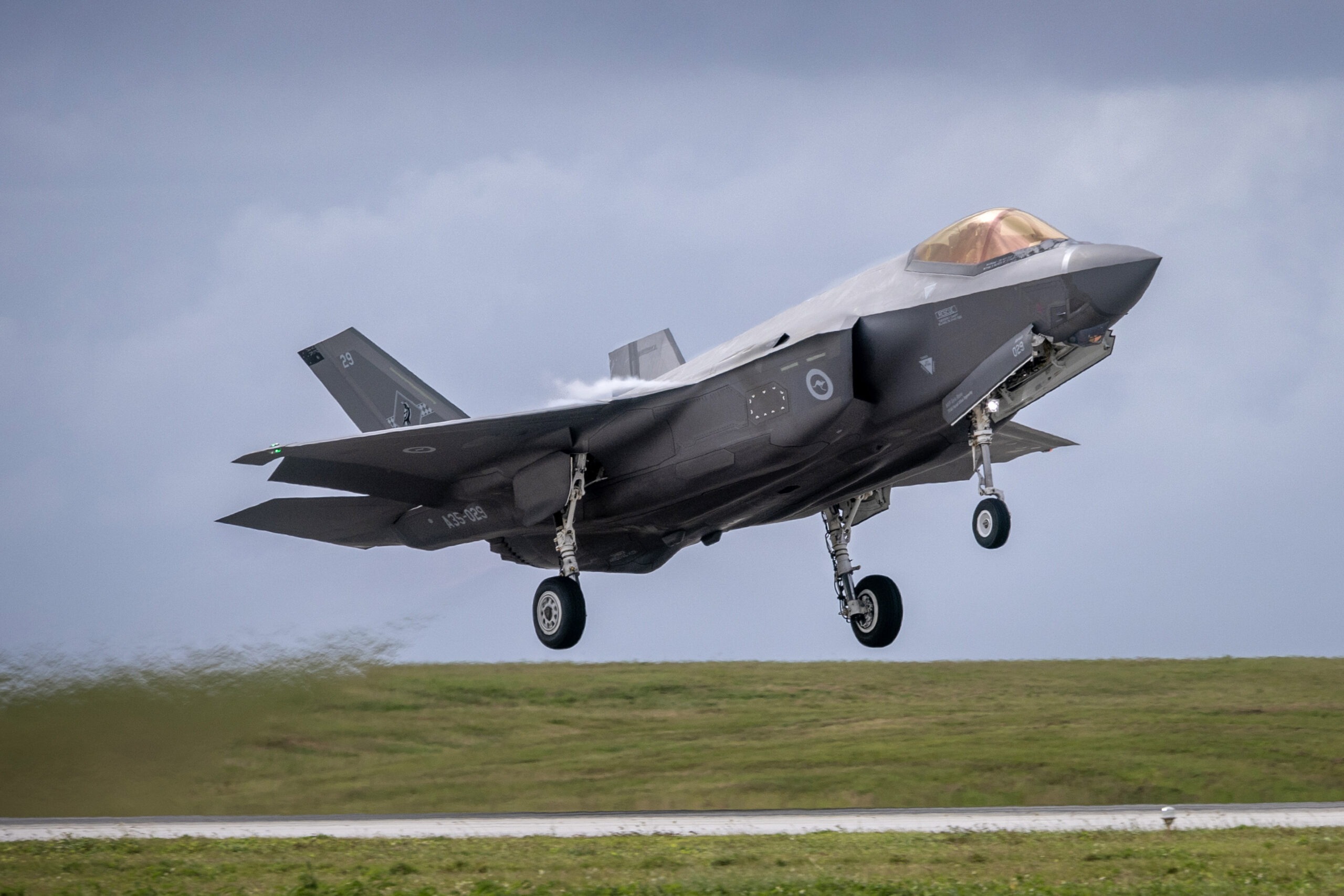
The Royal Australian Air Force could increase pilot training capacity, reduce costs and make more efficient use of resources by using high-performance turboprop aircraft alongside jet trainers in the fighter training pipeline.
The RAAF’s present ability to deliver pilots is inadequate: greater capacity is called for in the Integrated Investment Program, Defence’s long-term spending plan.
RAAF fighter pilots currently progress from basic and advanced flying training on Pilatus PC-21 turboprops to lead-in fighter training (LIFT) on the BAE Systems Hawk 127, then to operational conversion on frontline aircraft such as the Lockheed Martin F-35A and Boeing F/A-18F.
Using jets for LIFT was a logical choice when Australia chose the Hawk in 1996. At that time, the gap between the capabilities of turboprop and jet trainers was large, simulation technology was limited and realistic preparation for flying fighters depended heavily on aircraft performance. Today, those factors have changed.
Fundamentally, fighter technology and, with it, the nature of air combat have evolved. Modern combat aircraft still demand high flying skill but are more complex to employ as weapons, with success increasingly dependent on a pilot’s information processing, situational awareness and decision-making under pressure. Air combat has shifted from a problem dominated by kinematics to one increasingly shaped by cognition.
Additionally, high-performance turboprop trainers have become significantly more capable. Such aircraft typically cruise at more than 600 km/h (330 knots), climb faster than 20 metres per second (4,000 feet per minute), roll at rates comparable to fighters’ and incorporate advanced avionics, embedded simulation, synthetic sensors, and tactical scenarios generated within the cockpit. With simulation in the cockpit, students routinely learn to use radars, datalinks and weapons that the training aircraft does not carry, building the cognitive and behavioural patterns fighter pilots employ on operational jets before getting there.
I recognise these developments partly because I work for a company that manufactures high-performance turboprop trainers, but it’s not the only one: several manufacturers now operate in this market.
The growing usefulness of turboprops in training fighter pilots does not mean jets are no longer needed. Certain training activities benefit from jet performance, particularly those involving high-energy manoeuvring and some advanced air combat elements.
But LIFT involves many other things. Students learn tactics, mission management, formation-flying responsibilities and weapons fundamentals. Jets and turboprops approach surface features, missiles, or other aircraft at different rates and ranges, but a trainee can be given equal time in which to make decisions by scaling the mission design with the speed of the aircraft. Students must still recognise threats, manage formations, execute intercepts, prioritise, make timely decisions, and build mental capacity for a frontline aircraft. These cognitive fundamentals are increasingly independent of the type of aircraft used and do not necessarily require jet performance to be developed effectively.
This matters because Australia must generate enough qualified aircrew for fast-jet, mission aircraft, and future fleets. Training aircraft, instructors, and flying hours are finite resources. Every instructor posting, sortie, and training hour is a resource that cannot be spent elsewhere. Improving training efficiency therefore affects how quickly Defence can generate combat-ready aircrew.
The economics are significant. Frontline fighter aircraft cost upwards of A$60,000 per flight hour to operate. Jet trainers cost substantially less, around A$20,000 per hour, and advanced turboprop trainers around A$5,000 per hour. Relative acquisition costs follow a similar pattern. Turboprops also generally spend less time in or awaiting maintenance, which for them is also cheaper.
Using turboprop aircraft for training tasks that do not require jet performance could increase training capacity by allowing more flying for a given budget, while slowing the exhaustion of the Hawks’ operational lives. Greater flying exposure would also give trainees more time on the controls, still the most effective way to develop airmanship and proficiency.
Several air forces have moved in this direction. France replaced its former jet-based training pipeline entirely with turboprops. Switzerland also trains fighter pilots on turboprops, with plans to transition to the F-35 without a jet trainer.
A hybrid model may prove most effective for preparing pilots to fly fighters: assigning each learning outcome to the simplest aircraft that can credibly deliver the intended training effect. The objective would not be to replace jets, but to reserve them for activities that genuinely require jet performance.
As Defence considers its Future Lead-In Fighter under project Air 6002, the key question is not whether Australia needs a new fleet of jet trainers – it does – but how much of the preparation of fighter pilots needs jet performance. Thirty years ago the answer was ‘most of it.’ Advances in simulation, training systems and turboprop aircraft performance suggest a different answer today.













Leave a comment