


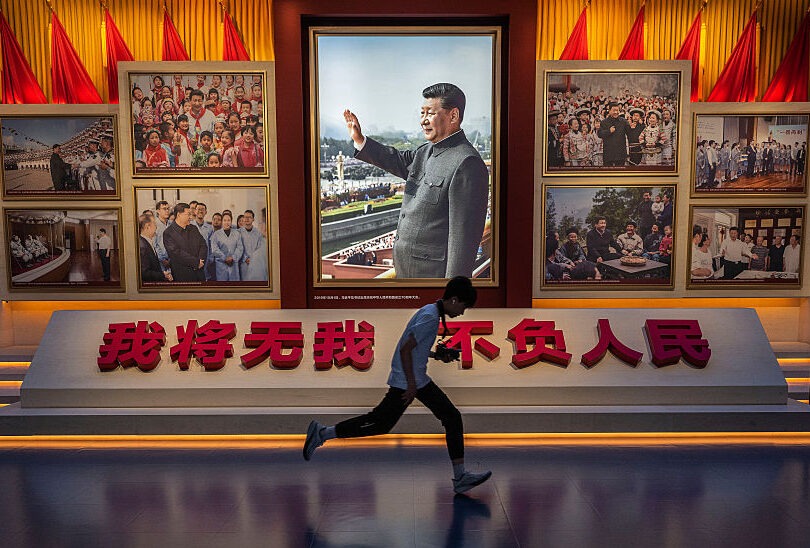
When China’s supreme leader Deng Xiaoping in December 1978 announced the ‘reform and opening’ of China’s economy, many expected that this would be accompanied by a gradual shift from authoritarian rule to a more liberal and democratic society. Instead, under Deng and his successors Jiang Zemin and Hu Jintao, political reforms stagnated, and under Xi Jinping China has actually taken a step back to a much harder form of authoritarianism.
In The Broken China Dream, Minxin Pei explains how this happened. Pei is a professor of government at Claremont McKenna College, has published several acclaimed books on China’s political system, and has had opinion pieces featured in the Financial Times, The New York Times, Nikkei Asia and The Wall Street Journal.
Pei argues that Deng’s economic reforms were never meant to move China towards democracy and were simply intended to consolidate the position of the Chinese Communist Party. Deng did not want to turn China into a capitalist society. Rather, introducing a market economy was a means to preserve the communist party-state.
At the same time, Pei emphasises that most of China’s senior leaders have been just as surprised as the rest of the world by Xi’s assertive push to revive totalitarianism.
Is there a connection between Deng’s new economic model and Xi’s hard-line policies? As Pei sees it, Deng intentionally left China’s Leninist institutions intact to safeguard the political monopoly of the CCP. To prevent another Mao-like figure from rising to power, Deng established collective leadership and put in place age and term limits. However, these guardrails proved to be weak and unenforceable and generally did not apply to senior leaders.
During the pre-Xi period, totalitarianism was largely dormant. But once Xi came to power, he ignored the checks and balances Deng established and pushed through an amendment of the explicit term limit on the presidency. With the political institutions intact, to gain near-absolute power Xi simply flipped the switch to reactivate the old system.
Western support for China’s economic reforms, including embracing its membership in the World Trade Organization, was premised on the assumption that economic development would lead to democratisation. Pei considers this a critical misjudgement. Modernisation theory highlights the correlation between economic growth and democratic regimes, but the causal link is far from clear.
Pei also highlights the need to distinguish between authoritarianism and totalitarianism. There are many historical examples, from Indonesia and South Korea to Spain and Taiwan, of authoritarian regimes transitioning to democracy, but few of totalitarian regimes successfully reforming.
The Chinese political system is frequently considered relatively stable, but Pei reminds us that it is actually based on a delicate balance of power between competing CCP factions. This is particularly evident during leadership transitions.
The 1980s were a turning point, marked by a tug-of-war between reformists, pragmatists and hard-liners. Party secretary Zhao Ziyang wanted to reform not only the economy but also the political system. However, at the height of the Tiananmen demonstrations in April 1989, Zhao went on a short trip to Pyongyang. This gave his hard-line rival Li Peng the opportunity to secure Deng’s approval for a tough approach to the demonstrators. In the months that followed, Zhao was ousted and replaced by the technocratic Jiang Zemin.
Pei speculates that if Zhao had not visited North Korea, history might have taken a different turn. He describes the chain of events that followed as ‘a historic tragedy of epic proportions’, where China missed its chance to reform.
Pei also reminds us that Xi’s rise to power was far from inevitable. At the 2007 party congress, Xi and his reformist rival Li Keqiang were vying neck and neck for the CCP’s number two slot, a stepping stone to becoming general secretary five years later. Eventually Xi won. And in 2012, Xi had to work hard to oust Bo Xilai, a well-connected and charismatic contender for a leadership position that could have undermined Xi’s authority.
The CCP’s next party congress will take place in late 2027 and is widely expected to confirm Xi for a fourth five-year term as head of the party. Extending Xi until 2032 would consolidate his position as China’s longest-serving and most powerful leader since Mao Zedong.
However, there is significant opposition to Xi’s rule, and China’s next generation of leaders are already waiting impatiently in the sidelines. The next step in Xi’s power grab is unlikely to succeed without another behind-the-scenes struggle. The Broken China Dream provides China watchers with valuable pointers about what to look out for in the lead-up to the 2027 party congress.









Leave a comment