


A debate is raging among close observers of Chinese AI: will it stay open-source, or will it close off?
The most likely answer is that there’ll be a bit of both.
Chinese AI labs are known for releasing their models to the general public for free – that is, making them ‘open source’, meaning that their source code, or ‘weights’, are available for downloading and use. This has enabled rapid adoption of Chinese models by other AI developers around the globe for a wide variety of AI products. But estimates suggesting a Chinese lab could be as little as four months away from creating a product like Anthropic’s Mythos – a model too powerful to release to the general public – have fuelled speculation that China’s open-source era may be drawing to a close.
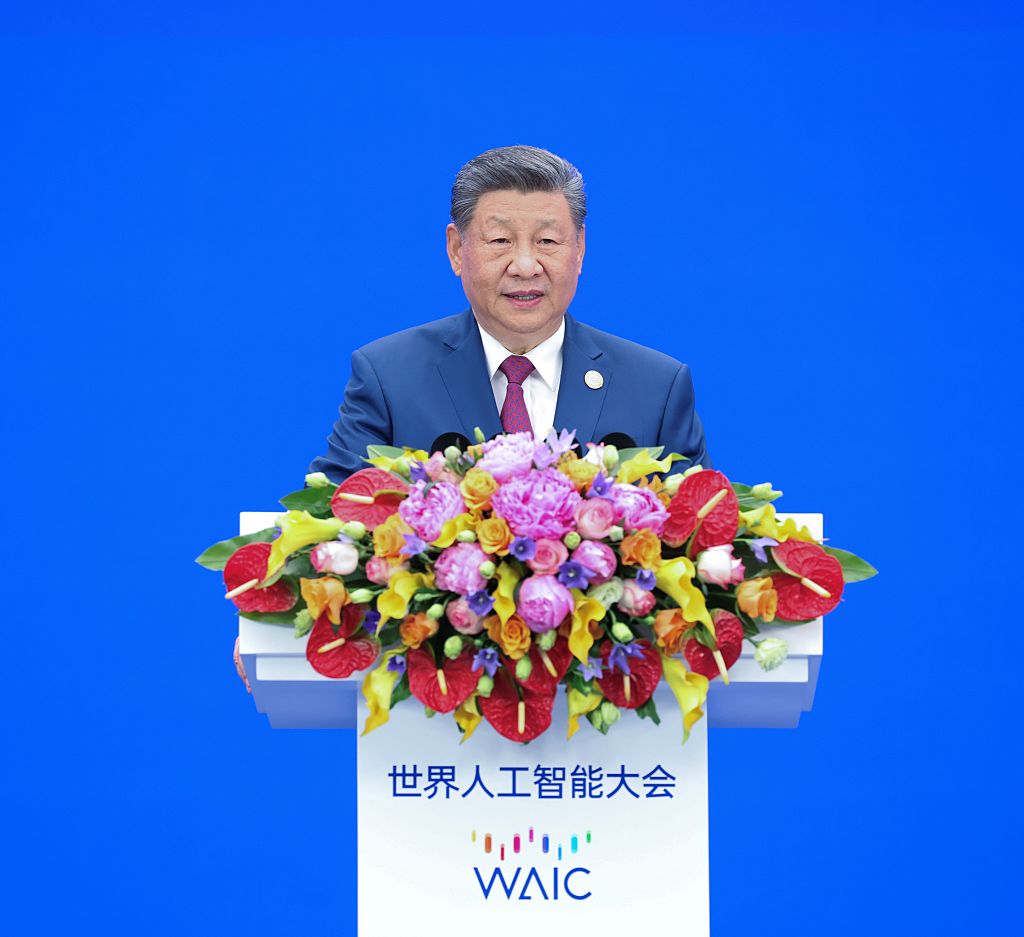
President Xi Jinping seemed to answer the question last week in his speech at the World AI Conference in Shanghai, when he endorsed ‘open-source and openness’ as the future for international AI development and governance. Newspapers including the Wall Street Journal and commentators elsewhere interpreted this as Xi endorsing open-source AI models.
But the problem is that Xi did not do so specifically. A detailed reading of his speech, and the pattern of recent model releases from Chinese AI labs, points to both open- and closed-source models having a place. Policymakers must bear in mind that the two are not mutually exclusive for China, especially since both serve the national interest. So we will likely see a combination of opening up and closing off.
Recent developments beyond a possible Mythos equivalent have thrown the open-source policy into doubt. Media outlet ChinaTalk pointed out in April that some Chinese AI labs had started keeping the weights of their latest AI models proprietary. It concluded that in the future they couldn’t afford to train expensive models then release them for free. This month Reuters reported a ‘silicon curtain’ could rise around Chinese AI. The news agency revealed that the Chinese government had been in closed-door meetings with Chinese AI labs about restricting international access to their frontier AI models.
But other signals over the past month point to a continuation of the open-source policy. Start-ups Moonshot AI and Z.ai made headlines for releasing large open-source AI models, the latter releasing its product just a day after Anthropic had cut international access to its latest model, Fable 5. Matt Sheehan, a senior fellow researching Chinese AI at the Carnegie Endowment for International Peace, argues that open-source has too many political advantages for the CCP, so it’s unlikely to be dropped. This interpretation, combined with Xi’s World AI Conference speech, was the clincher for commentators who concluded that China would continue to keep its AI models open-source.
Open- and closed-source have always had their own supporters in China’s AI industry. Throughout the 2010s, Huawei used open-sourced computer code to build its own operating systems. In 2021 the Chinese government made it a priority to encourage institutions to open-source their code in the 14th Five-Year Plan, arguing that the practice sped up the scientific and technological development. Also, releasing its latest model for free can give an obscure AI lab publicity, though doing so can also lead to the lab taking a loss: the models are expensive.
The debate can split labs down the middle. When I visited China in May, technicians from Moonshot told me that while their research team favoured open-source, because of what it allowed them to build, the marketing team wanted the stronger revenue of closed-source.
ByteDance, one of the most influential players in Chinese AI, balances this by open-sourcing some models while keeping its flagship image and video-generation models closed-source. Of all the companies that have open-sourced their flagship models, only one has actually quietly stepped back from it: whereas Alibaba released the weights of earlier models, its latest, Qwen-3.7, is proprietary, its code unavailable for download. Yet Alibaba said on July 19 that the next iteration, Qwen-3.8, would be open-source, likely because Xi called for openness (yet not necessarily open-source). So, while there is pressure to conform to open-source within China’s AI ecosystem, there is also room for flexibility.
There were other signals from the World AI Conference auguring tolerance for closed-source. The statement from the chair of the High-Level Meeting on Global Governance of AI reads like a list of policies China has already enacted on AI. In it, there is a line about the need to build an open-source ecosystem, as ‘an important path to the inclusive development of AI.’ However, governments should ‘respect enterprise’s independent choices’ around such issues as intellectual property. This suggests the focus is to promote open-source to create a healthy AI ecosystem – but that if a company needs to turn proprietary to avoid going bankrupt, that is also acceptable.
When commentators point to Xi’s speech endorsing open-source, they should ask themselves: what does ‘open-source’ mean in a speech from the Chinese leadership? It’s important to remember that a Western concept can be imbued with different overtones when used in China. In his speech at the conference, Xi Jinping did not mention ‘open-source’ per se, but instead a four-character political slogan, ‘open source and openness’ 开源开放.
That slogan first appeared in 2017 along with the first official Chinese AI policy document, which sketched out China’s international AI policy, and it seems to be a broad term referring to sharing any AI resources, such as research or software, that could contribute to the technology’s development. Before AI models like ChatGPT arrived in late 2022, ‘open source and openness’ in state media referred to a variety of AI-related technologies, including cloud computing and data sets. While the slogan now includes AI models, it is still interpreted loosely. For example, Xinhua used it in March to talk about open-sourcing AI chip architecture. So what Xi was promising in his speech had more to do with the idea of open-source AI as a whole, rather than any specific part of it. The term is broad and vague enough to allow for open-source AI models to be taken off the table if required.
Even in English, ‘open-source’ is a very loose term, with industry experts now preferring ‘open-weights’ to refer to AI models that have had their weights released to the public, but not other key ingredients, such as their training data. Chinese does not make this distinction, allowing ‘open-source’ to become a loose umbrella term for several different aspects of AI. In speeches and press read-outs surrounding the World AI Conference, ‘open-source’ was used to refer to multiple parts of AI – not just AI models, but also research experiences, developer tools and data sets. Even then, guarantees to provide the world with open-source AI models do not mean that these must be frontier models. As shown earlier with Qwen and ByteDance, Chinese AI labs are still free to make the weights of their own frontier models proprietary if they choose to.
From a strategic standpoint, this could make sense in a hypothetical future where Chinese models overtake US ones in terms of intelligence. One of the Reuters reports rightly said that China’s leadership was ‘now treating cutting-edge artificial intelligence as a critical national asset that needs controls.’ But leaders in both the US and China know that to win the AI race, openness and restrictions are both necessary.
As it catches up to the US on AI capabilities, China is starting to wrestle with a dilemma that several US administrations have faced for years: how do you boost your international influence through adoption of your own country’s AI products while ensuring these products aren’t used to harm your national interests? The Biden administration tried to walk a narrow line –encouraging the sale of US AI products overseas while also enforcing an intricate set of export controls on AI chip sales to countries it considered a threat. Similarly, in the US AI Action Plan, the Trump administration says it aims both to roll out US AI products worldwide and become the ‘gold standard’ for the world, but also ‘prevent our advanced technologies from being misused or stolen by malicious actors.’
There are signs that key actors in China’s AI industry also think the two strategies are complementary. In May last year, Tang Jie, co-founder of Z.ai and a professor of computer science at Tsinghua University, wrote an interpretation in People’s Daily of how Xi Jinping Thought, a political doctrine, should be implemented in the AI industry. Building on a passage from Xi about technological self-sufficiency, Tang wrote that the industry must treat open-source and closed-source as ‘two legs’. When used together, they would be ‘serving the ecosystem to develop and safeguarding national security.’ Stakeholders around the world can expect China to continue open-sourcing a wide variety of items that are used to build AI systems. But they should not be surprised if the country is less willing to share the weights of a frontier AI model of unprecedented power.









Leave a comment