


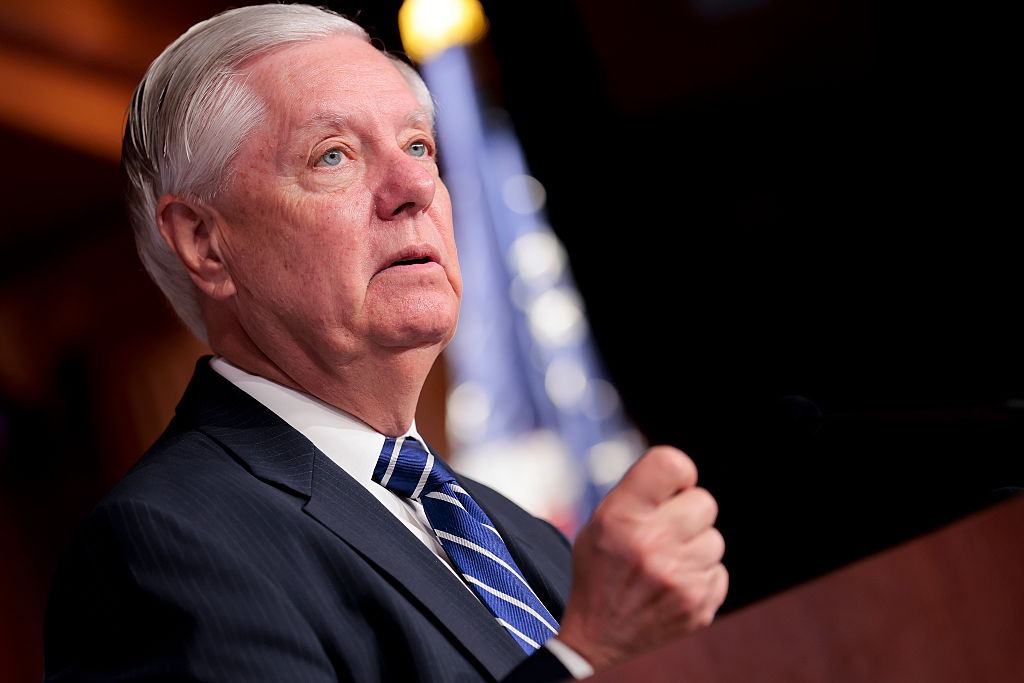
The sudden and unexpected passing of Senator Lindsey Graham at age 71 will directly affect how the United States conducts itself around the globe, and for the better.
The Republican from South Carolina was the ultimate political survivor. Although Graham had plenty of enemies in both parties, he was about to win a fifth term in the US Senate in November and had been a powerful figure in Washington from the 1990s until the day he died, 11 July.
He was the last of the 13 House managers for Bill Clinton’s impeachment in 1998 to still serve in Congress. Democrats specifically targeted that group for defeat, but they never succeeded with Graham.
Amazingly, Graham became an indispensable partner and confidant to both John McCain and Donald Trump, adversarial political figures. Notably, one of candidate Trump’s first controversies was his shocking criticism of former Vietnam prisoner of war McCain: ‘He’s a war hero because he was captured. I like people who weren’t captured.’
In the Senate, Graham moved from committee to committee, often setting the agenda or at least making himself a factor in the burning issues of the day. Supreme Court nominations in the Judiciary Committee, defence policy at Armed Services, spending issues on Budget and Appropriations committees – he played a key role in all.
His most important impact was on US foreign policy. As a 30-plus-year veteran of the US Air Force and its reserves, including while he was a sitting senator, he both served in harm’s way and helped shape the policies that guided US decision-making.
Like his late friend and colleague McCain, he relentlessly spoke up for freedom fighters around the globe – in Ukraine, China, Iran, Cuba and Venezuela, just to name a few. Notably, he died just hours after returning from his 10th trip to Ukraine since Russia’s 2022 full-scale invasion – an arduous journey under the best of circumstances.
His most distinguishing characteristic was that much more so than most senators, he was willing to do whatever it took politically, including bending his personal preferences, to achieve his international policy goals. His public life was dedicated to supporting robust American leadership on the global stage, a principle that became increasingly difficult over the past 20 years, particularly in the Republican Party.
When Trump first came on the US political scene a decade ago, Graham not only ran against him for the Republican nomination but also harshly criticised Trump’s presumed isolationist approach to foreign policy, saying that Trump would make a ‘terrible commander in chief.’ (Trump responded by calling Graham a ‘disgrace’, a ‘nut job’ and ‘one of the dumbest human beings.’) As Trump won the nomination and the presidency in 2016, Graham changed his tune and built a relationship despite Trump’s considerable personal baggage and malleable politics.
Graham became a trusted adviser to Trump, while advocating for Ukraine, a strong NATO and a tough line on China – all issues on which Trump had demonstrated alarming flexibility (at least to national security conservatives). Graham’s closeness to Trump earned him much criticism, from Democrats of course, but also from Never Trumper Republicans who felt Graham had betrayed his principles and McCain.
This criticism misses the point entirely. Graham’s loyalty and counsel to Trump were worth vastly more to the cause of freedom around the world than anything done by Never Trumpers in the Republican Party. As a political leader, he was willing to endure the critiques of his loyalty and steadfastness to be in a position to promote American leadership. His sacrifices should be seen as honourable and effective.
For many of us who worked in Congress on US leadership, Graham’s passing – along with Senator Mitch McConnell’s bad health and retirement – marks the end of an era.
For decades in public life, Graham personified the foreign policy decision-making scheme of the US Constitution, which calls for collaboration – and tension – between the president and Congress, particularly the Senate. With McCain, McConnell and other senators, including Bob Corker and Marco Rubio, Graham was a critical voice for American leadership in a Republican Party that is in the midst of reconsidering almost all of its policies, particularly in the international arena.
This is, at least in part, the purpose that the constitution allocates the US Senate – to give power to a group of American leaders with a long-term vision of US interests who can challenge but also partner with the chief executive and in that interaction, make better policies for the American people and the world.
New senators will have to step up, demonstrate leadership and compromise without losing focus on what really matters. They have no better model than Lindsey Graham.















Leave a comment