



The following is a speech delivered by ASPI executive director Justin Bassi at the Australian Defence Science, Technology and Research Summit, held in Adelaide from 4 to 6 August 2026.
Just over 10 years ago, I sat in the oval office with my then boss Malcolm Turnbull and President Obama listening to them debate the Thucydides Trap. This is a theory that has made Graham Allison famous but for which, in my view, there is no modern-day example – where the established power is so anxious about the rising power that it strikes at the rising power and starts a war.
It is a debate that has been fun for some, and with repressed memories for others, but the theory has actually only benefited China. It has seen the West go out of its way to refer to China as predominantly an economic partner and tie itself in knots about being strategic rivals. This has constrained our ability to compete technologically with China, and instead we have actually helped China’s path to tech dominance.
And while the Thucydides Trap is a red herring for wars, it does exist within Western tech companies. And if we do not change our ways, our desire for intense technological competition within and among Western nations, with economic outcomes prioritised over geostrategic, will again benefit only China. We are not just playing on an uneven field, we are at times not even in the park. That’s the key I’d like you to take away today, so more on that in a bit.
But first, how did we get here today, with technology being so important to not just economic prosperity but central to the democratic versus authoritarian battle for global supremacy?
Many people forget that at the centre of the Cold War sat technology: the space race and arms race were about tech, but about more than space and weapons. They were about global standards, safety, security and supply.
And when politicians and analysts talk about strategic competition between the US and China, or about Cold War 2.0 or just strategic competition, tech once again sits at the centre of it. This time, though, it is even more challenging for the West.
The current era is often referred to as the most dangerous time since the end of World War II. In fact, it is one of the judgments on which we have bipartisan agreement in Australia. Think about that – more dangerous now than at any time during the entire Cold War.
We have war in Europe for the first time since WWII, which has seen Russia at war for longer than it was at war with Nazi Germany. And we have had a devastating conflict in the Middle East since October 2023 and with major state on state conflict since February this year – all with international implications, from social unrest and the Bondi arson attacks to global fuel and economic insecurity.
But there’s a risk in such assessments of limiting our strategic thinking only to wars, or what to do the day after war. That limited thinking may arise through political and diplomatic desire for positive relationships and meetings; military planning about wartime scenarios; media priority on clickbait; or lack of public interest unless there is a crisis. Either way, it risks ignoring or making secondary all the activities and behaviour happening in areas just short of war by authoritarian states –whether foreign interference, sabotage or, in my view, technology-based dependency and coercion risk.
It means for Australia and our region, we can’t afford to make the mistake of saying: well we don’t have war here so all is okay, or that we are only indirectly affected by far-away wars.
Yes, it is true that the Indo-Pacific doesn’t have the wars of Europe or the Middle East. But neither of those wars came from nowhere. Both were the result of periods in which the aggressors – whether authoritarian regime or terrorist group – were allowed to feel empowered by the rest of us not taking decisive action against their initial non-war actions. They were testing our resolve and we failed their tests. And thus we failed to deter war.
What does it mean for us? In our neighbourhood, we have rising tensions over Taiwan, with Beijing making it clear that its primary objective is to take over the island, and by force if necessary. We also have China, in direct contravention of an international ruling, bullying the Philippines – including dangerously ramming fishing vessels and striking personnel. We just had the 10th anniversary of the Hague’s international ruling that confirmed that China’s nine-dash line is a fiction. But China simply ignores the decision.
We ourselves were circumnavigated by the PLA Navy during our election campaign. We have seen regular unsafe release of flares or activities by Chinese aircraft in front of RAAF P-8s over the South China Sea. And, of course, just a few weeks ago we saw the test of a submarine launched ballistic missile land in the Pacific. All these have been attempts to simultaneously bully, normalise these aggressive activities and desensitise our public.
Not to mention that we have daily cyberattacks – not limited to the stealing of commercial secrets, though that is a large part of it. Even more concerningly, the US, Australia and our partners have China sitting on our critical infrastructure. This would give them the ability to disrupt at any time – what former head of the Australian Signals Directorate, Rachel Noble, has described as ‘digital dynamite’.
So, this is the environment in which we find ourselves: not so much a security environment but an insecure one.
This is why national leaders and policy makers need to consistently examine the strategic landscape, including on the lessons to draw from history. If we don’t, we will consign ourselves to repeating the same mistakes, including an approach which merely involves hoping tensions do not turn into conflicts and thinking there’s nothing to be done until after the first bullet is fired.
We, of course, made that mistake leading into World War II. Thankfully we learned that lesson in the Cold War. Yet after the Cold War ended, we stopped our learning. We developed economically and technologically – Unbelievably so. But the end of history, as Francis Fukuyama put it, saw not so much an end but a forgetfulness. And we proceeded to let history repeat – whether by thinking China’s entry into international institutions like the World Trade Organization would liberalise China or whether it was Europe thinking that reduced spending on defence and increased trade with Russia would avoid conflict.
And simultaneously with remembering what aggressors do, we need to remember what our responsibilities are, how we protect ourselves and deter others, and why we have partnerships, such as the US alliance and AUKUS.
It’s to help us be more than the sum of our parts, and to achieve that we must remain open to our own vulnerabilities, not just look at where we are today but what needs to happen tomorrow. We need to adapt to avoid being the next Kodak or Blockbuster: individual companies all thinking they were okay or, worse, a nation considering itself already developed and in no need of ongoing development, even as competitors rise. We also need to avoid, as former US deputy national security advisor Matt Pottinger has said in response to the US selling high-end chips to China for soybeans, thinking the free market will always favour us while we, in fact, ‘go back to being an agrarian country’.
We need to stop saying western innovation – our tech, our capabilities and how we use them – is just inherently better. We said that about the use of the internet in 2000. President Clinton was so confident of American control of cyberspace that he actually wished Beijing good luck. And China and Russia proved us wrong.
We said after the Arab Spring began in 2010 that China and Russia wouldn’t be able to control social media, and we were wrong. Elon Musk in 2011 mocked the prospect of competition from China’s BYD in electric vehicles. And he has been proven wrong. Too many said in 2016 that China’s 5G offerings would be unable to compete with western tech. Wrong again.
By 2018, US and Western assessments were that while China could hack, it could not innovate to develop a competitive social media platform. TikTok is now the favourite individual platform for teens and has surpassed all other apps to become the top social media app for news consumption for anyone under 30.
We were also wrong when we said China would not succeed in innovative areas like AI due to its centralised political and economic system. Then DeepSeek came out last year and blew away those assumptions.
We really have to stop being wrong. Or at least to stop thinking we are always right.
Because this time, in the era of tech development supercharged by AI, there’s a risk we might not be on the side of who is most powerful and therefore we might not be able to catch up after a crisis. For the first time in modern memory, the nation posing the most threats to Australia – under sea, on the sea, in the sky, in cyberspace and in space itself – is our largest trading partner.
That immediately distinguishes the current era of strategic competition from the Cold War.
But beyond the economic challenges with which most people are aware, we’ve never had the strategic adversary be so technologically dominant. We never relied on the Soviets for tech. They were – after their initial successes in space – always a generation behind the US. And, of course, well behind in their economic capacity to sustain their progress.
America was the manufacturing powerhouse in WWII and the Cold War. But it is now China that dominates manufacturing of goods and materiel.
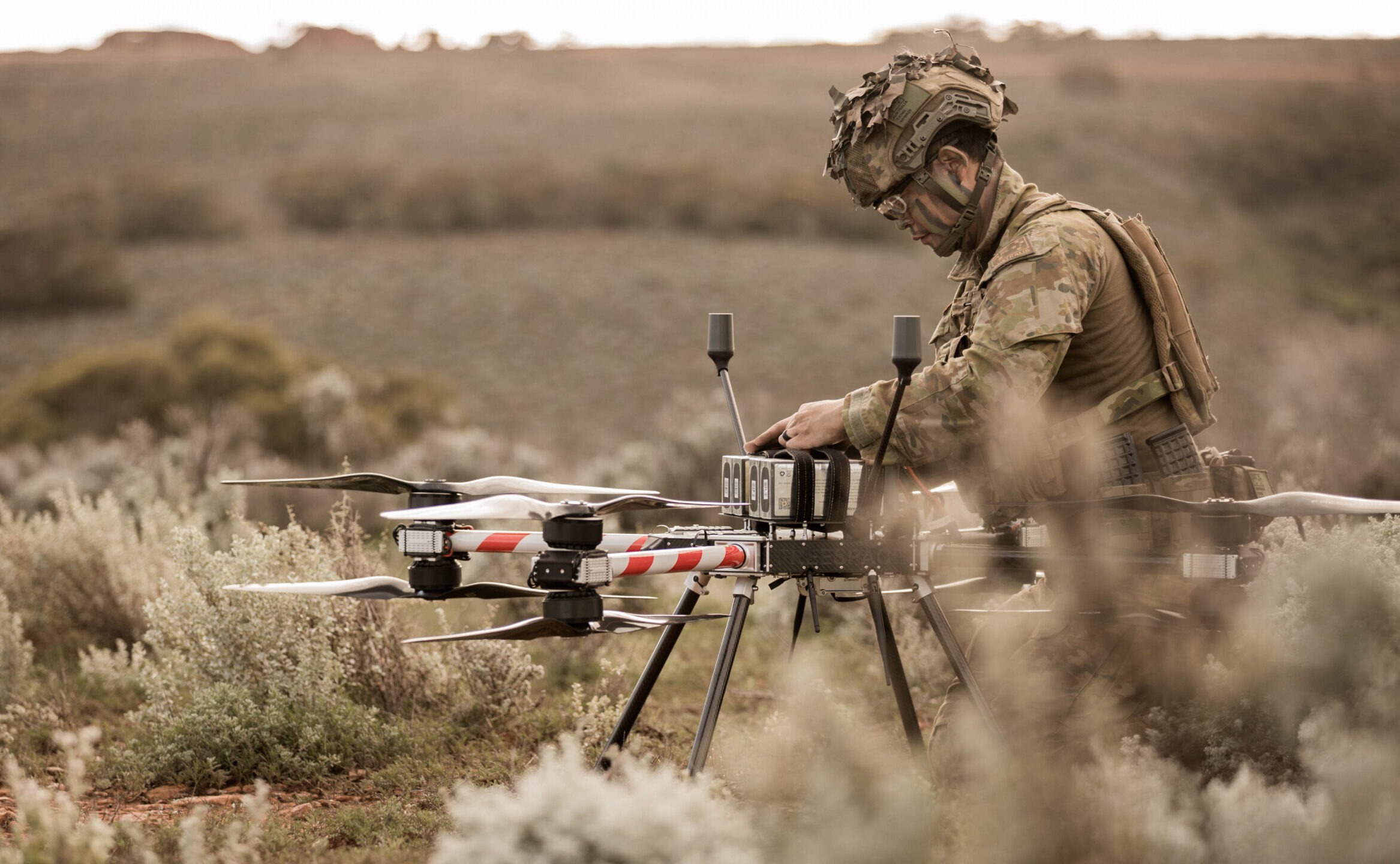
It is China’s research and development of tech that is globally leading, including in many of the fields our own government considers critical and on which our society relies. Smart cars, drones, batteries, solar panels, social media. We cannot afford to add AI to that list.
ASPI’s critical tech tracker, which involves a 20-year look at global research into critical technologies, shows the trends. High-end research into 69 of the 74 critical technologies is dominated by Chinese companies and institutions.
China is using predatory trade practices to first push western companies out of business, then ensure our nations are so dependent on China that we cannot stand up to China’s aggression and coercion. ‘Resistance is futile’ is their message.
We have to be willing to deal with this issue now – before a crisis – and not rely on the argument that China is separate to Russia. Try telling that to Ukraine, the Philippines or Taiwan.
The message is: let’s not be Europe in 2022. And let’s also not repeat our own recent history.
In 2009 we released a defence white paper that set out the threat of China’s military and tech rise. That paper said we needed more submarines and defence spending. But the global financial crisis hit and so we collectively pushed security to one side and focused on short term economics. It worked for a few years but amounted to merely kicking the can down the road. By 2015 we were being targeted online, in our critical infrastructure and even in the heart of our democratic institutions – with what we know now as foreign interference.
So we can’t afford to return to failed policies of economics trumping security.
Focus on sovereignty rather than the impossible balancing of economics and security – even though such a balance is a good political line. In the decision-making process, we should ask ourselves: does this policy impact our ability to continue making national security decisions for ourselves, or does it give a vote or veto power to a foreign government? If it is the latter, the answer must be to not proceed with it, even if it’s a money maker.
In the tech space, we need a comprehensive policy so we aren’t just responding reactively to the latest development. From Huawei to Hikvision to DJI to BYD to TikTok to DeepSeek, there will always be the next one. Why do we wait for them to enter the market before banning them from government and critical infrastructure?
If you catch them only once they are both in our market and dominating it, then it becomes too difficult to address.
Those technologists with blind faith in tech as only a public good are analogous to the economists who had blind faith in the free-market economy being right every single time. In few other fields beyond the economy and technology are there so many educated people who think some regulation by government equates to big brother.
One of the biggest debates in AI right now is between those who favour some regulation of frontier models and those who believe that open-source, open-weight models which naturally resist regulation are the pathway to equitable global growth.
The debate is often reduced to public safety and national security versus access and innovation – as though they are opposites that cannot co-exist. But as we saw with global trade, technology without standards set and enforced by rule-abiding nations can easily devolve into a Wild West. Players who are willing and able to throw their weight around on the field can then have their way at the expense of others who want to do the right thing.
We opened the trading system without requiring standards and China stole, bought, subsidised and manipulated global trade in the face of an impotent WTO.
In tech, China was so confident by 2015 that it actually warned us what it would do in terms of supplanting the US in global tech supremacy. And it has gone about achieving it.
With the advent of AI, we may have only one more chance. Don’t just give it to China. Make its job harder. Which means not allowing China to have access to our best tech and not allowing Chinese tech into our critical infrastructure. Classify AI as digital critical infrastructure.
Regulate for national security first. This should mean assessing new models for release and then releasing them in a careful and prudent way, with safeguards in place that both ensure security and cannot be easily removed by the user.
The argument that promoting proprietary models with safeguards mandated by regulation is in the financial interests of OpenAI and Anthropic might be right. But it is also right that those like Nvidia and Meta and others arguing for openness are arguing in favour of their own financial interests. As I said at the start: the tech industry Thucydides Trap.
Each time a new tech company rises, the existing ones try to fight for their lives. Microsoft did it with Netscape in the 90s. It is the tech industry doing what it does. So, governments have to do what they are supposed to do: act in the national interest.
Governments can’t just act on the basis of the views of tech companies. Governments made that mistake when told by the tech leaders not to interfere with social media 20 years ago. Governments are trying to unwind that mistake today.
And it’s why, in addition to our own national security policies, we need to work with allies and partners including across the Quad and G7+ processes.
It’s why AUKUS is crucial. On that I will leave you with this view: the three AUKUS governments should stipulate that, if you do business in China, you cannot be a part of AUKUS. This wouldn’t ban businesses operating in China, but it would incentivise patriotic innovation and investment.
Not acting is not just refusing to learn from history and risking a repeat – a mere repeat would be okay as we have always been able to recover after a crisis and keep destiny in our own hands. Not acting now risks placing our destiny in the hands of our strategic adversary.









Leave a comment