


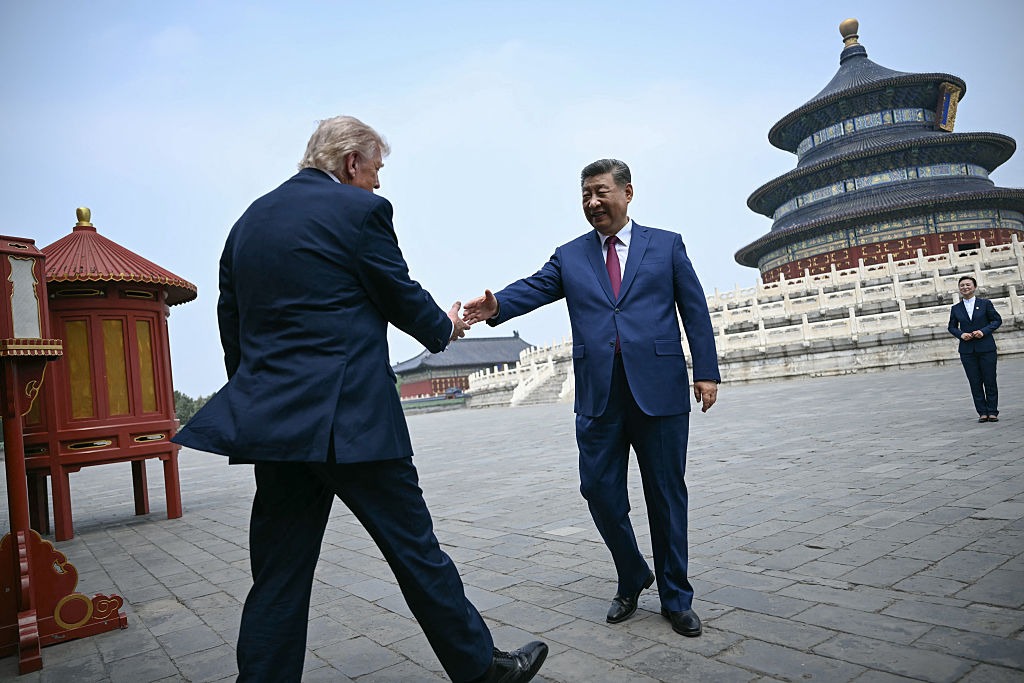
The stakes will be high in expected talks between President Donald Trump and Chinese leader Xi on AI safety and governance during Xi’s state visit to Washington on 24 September. AI and tech company executives will also converge on DC for the summit.
The United States and China both aspire to claim for themselves the wealth and power that AI dominance could bring. But the summit comes as top AI visionaries and engineers in the US have warned that unregulated artificial super-intelligence could bring about human extinction. Business interests, meanwhile, are pushing the idea that regulation of AI will only slow down innovation and make the US less competitive.
This debate looks different in China. The Chinese government has spent years creating a regulatory framework around AI that pushes a government-approved vision of AI safety – one that tries to take into account ethics and human needs while preserving the government’s requirements around information and social control.
Ideological risks posed by AI are a key concern for China’s top leaders. State security minister Chen Yixin warned this month that AI could be ‘leveraged by hostile forces’ to flood China with damaging information. It is in Beijing’s interests to ensure that global AI infrastructure and standards develop in ways that accommodate an authoritarian regime’s need for control.
The current US administration’s focus on minimal regulation as a means to speed innovation is thus missing a key consideration. Global influence doesn’t just come on the coattails of technological innovation; it is also built through the export of standards and regulatory frameworks. Making the rules around a new technology can help a country shape the rules to match the needs of its own domestic industry, better protect the rights and interests of its citizens – and, in China’s case, satisfy the demands of its repressive political system.
Right now, the US is largely absent from the race to regulate certain kinds of important technologies. The European Union has an influential data privacy regime, the General Data Protection Regulation, to which many websites around the world, including American ones, now adhere to maintain access in the EU. China too has built a data privacy regime that has strengthened its regulatory hand in international markets. The US has yet to pass a national data privacy law.
This regulatory race is already coming for AI. China has launched the Global AI Governance Initiative, the EU has passed the AI Act, India has the Global Partnership on AI, and the United Arab Emirates has declared a goal of shaping global AI governance. The US has no national laws regulating AI and has launched no formal global AI initiatives, though it discusses AI through multilateral processes.
When Trump and Xi meet to discuss AI safety, Xi will bring to the table an interlocking set of guidelines, laws and policies that China has built up over the past several years to regulate AI’s development and spur innovation. Xi can speak to years of experience with what works and what doesn’t – though what works for an authoritarian government may not be in the best interest of democratic societies. Trump can offer ideas and promises made by industry executives. But that’s not a model for international AI cooperation, and it doesn’t offer proof that democratic regulations on AI are superior to those offered by an authoritarian state.
The US administration is likely banking on the belief that leading the AI race will bring so much global sway that markets and standards will naturally shape themselves to follow the US’s lead. In the unipolar world of earlier decades, that plan could have worked. But Chinese AI labs are hot on the heels of US AI companies. And while US companies continue to lead in frontier models, Chinese companies often release their models as open-source to capture global developer adoption. Meanwhile, the Chinese government is making a full court press to shape global AI governance as well.
A stronger US approach would be to acknowledge that global AI governance – widely acknowledged as a necessity – starts at home and that regulation can itself be a lever of both hard and soft power.











Leave a comment