


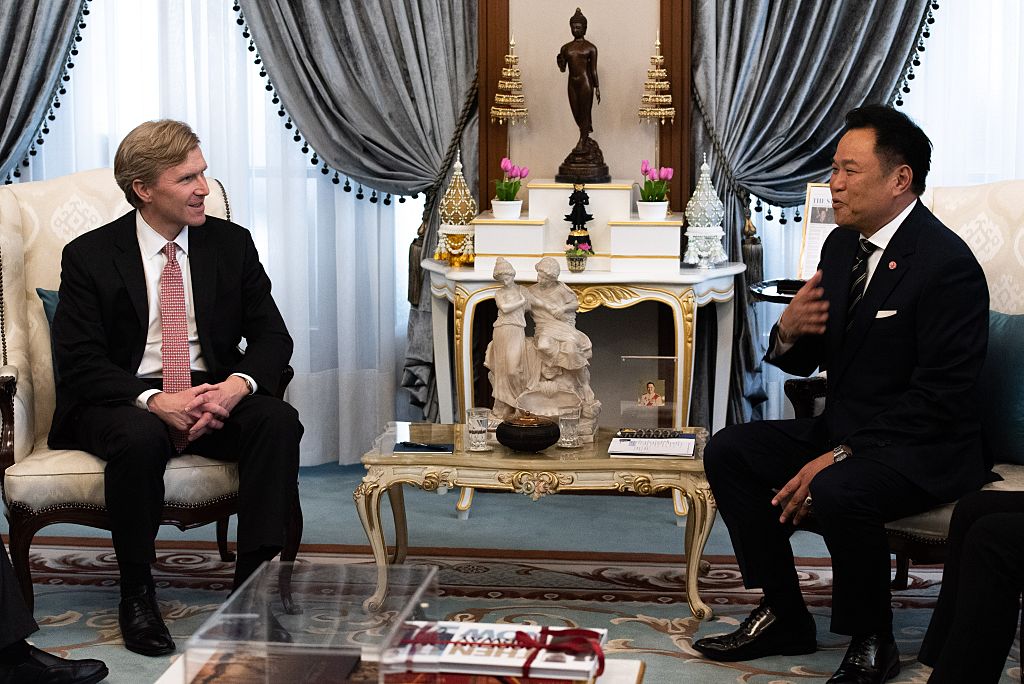
The Pentagon’s top policy official, Under Secretary of Defense for Policy Elbridge Colby, used his first Southeast Asian tour last week to make a pitch for why regional countries should partner with the United States to protect their sovereignty and security.
Travelling to the Philippines, Indonesia, Thailand and Cambodia, Colby laid out a pragmatic approach of ‘flexible realism’ and signalled an ambitious agenda for strengthening key regional partnerships. For Australia, both should be broadly welcome, though questions remain about how Australia can best work alongside the US in the region.
A central message of the trip was explaining how Southeast Asia fit into US strategy, with competing demands on US military assets sharpening questions about Washington’s priorities, and tariffs and aid cuts straining regional relationships. In a major speech in Manila at the start of the trip, Colby – a key architect of the administration’s national defense strategy – affirmed the US’s interest in maintaining a favourable balance of power in Southeast Asia and in sustaining deterrence along the First Island Chain. He pledged that under the administration’s framework of ‘peace through strength and common sense’, the US would pursue an approach of flexible realism in Southeast Asia, meaning it would partner with regional states in areas of mutual security interest without demanding ideological alignment.
The message was also that security partnership with the US was in Southeast Asia’s own interest. Speaking to reporters in Bangkok, Colby said Southeast Asian countries needed ‘a strong United States that’s active and engaged’ to preserve the regional balance of power. He spelled out a practical bargain: Washington could offer maritime support, intelligence, surveillance and reconnaissance capabilities, military equipment and training, while seeking operational access and collaboration in return.
Colby also pledged disciplined ‘strategic prioritisation’ of US resources and efforts in Southeast Asia while signalling an ambitious agenda for strengthening several regional defence relationships.
His first stop, the Philippines, showcased the dramatic deepening of the US alliance with that country. More revealing were the signals about what could come next in the region: ‘We feel that we’re going to really, hopefully dramatically, improve the strategic and defence partnerships with Jakarta and Bangkok,’ Colby told reporters.
The visit to Indonesia, a pivotal regional actor, showed how Washington must accommodate partners’ diplomatic balancing. Discussions about greater US access prompted Indonesian Defense Minister Sjafrie Sjamsoeddin to stress that Indonesia would not compromise its sovereignty, and during the visit the Indonesian navy was conducting an exercise with China.
Colby’s optimism about Thailand was more surprising, even though that country is a treaty ally of the US. Their defence relationship has lacked momentum, and Prime Minister Anutin Charnvirakul felt the need to promise not to downgrade US–Thai military exercises in response to US trade restrictions.
In Phnom Penh, Colby and Prime Minister Hun Manet pledged to resume US–Cambodian Angkor Sentinel army exercises. Washington sees an opportunity to give Cambodia more options beyond China for security cooperation and thereby limit Chinese influence and access.
Australia should welcome the pledge of a flexible realist approach and the ambitious US agenda in Southeast Asia. A US preference for practical cooperation over ideological alignment is broadly consistent with Australia’s regional approach in principle, even though Canberra has been unsettled by the US administration’s approach to trade and the liberal order. Washington’s Southeast Asian prioritisation also aligns closely with Australia’s, particularly in seeking to strengthen defence relationships with Indonesia and the Philippines and in supporting regional countries’ capacity to protect their sovereignty.
However, Colby’s message left some open questions about how Washington would seek to engage with external powers such as Australia in the region. In Bangkok, Colby praised Australia for ‘seeing things through the lens of collective defense and a strategy of deterrence by denial designed to sustain a balance of power in this key region’. But he also discouraged countries, presumably including Australia, from ‘wasting effort’ on middle-power strategies that excluded the US.
That leaves an important question for Canberra and Washington to work through. If stricter US prioritisation means allies and partners must shoulder more of the regional security burden, Australia will need to determine where it can do more in Southeast Asia and how those efforts should fit alongside US priorities. Canberra may welcome the stronger military balancing that Washington is offering while seeing it as only one part of the broader diplomatic, economic and institutional engagement needed to sustain regional influence.
Southeast Asian countries have reasons to be sceptical of the US pitch for closer partnership. US tariffs and aid cuts alienated regional partners, while the Iran war dealt an economic shock to the region. Defence ties can deepen despite those frustrations, but the Pentagon cannot insulate them from broader US policy.
The Pentagon’s approach in Southeast Asia must also compete for US resources and attention. The Iran war draws on US military resources while the administration pursues other priorities elsewhere. Questions from regional reporters reflected these tensions. They pressed Colby on what resources Washington was putting behind its commitments and what it expects Southeast Asian partners to give in return.
The Pentagon has clarified its preferred approach to Southeast Asia, but sustaining it will depend partly on decisions beyond the department.









Leave a comment