


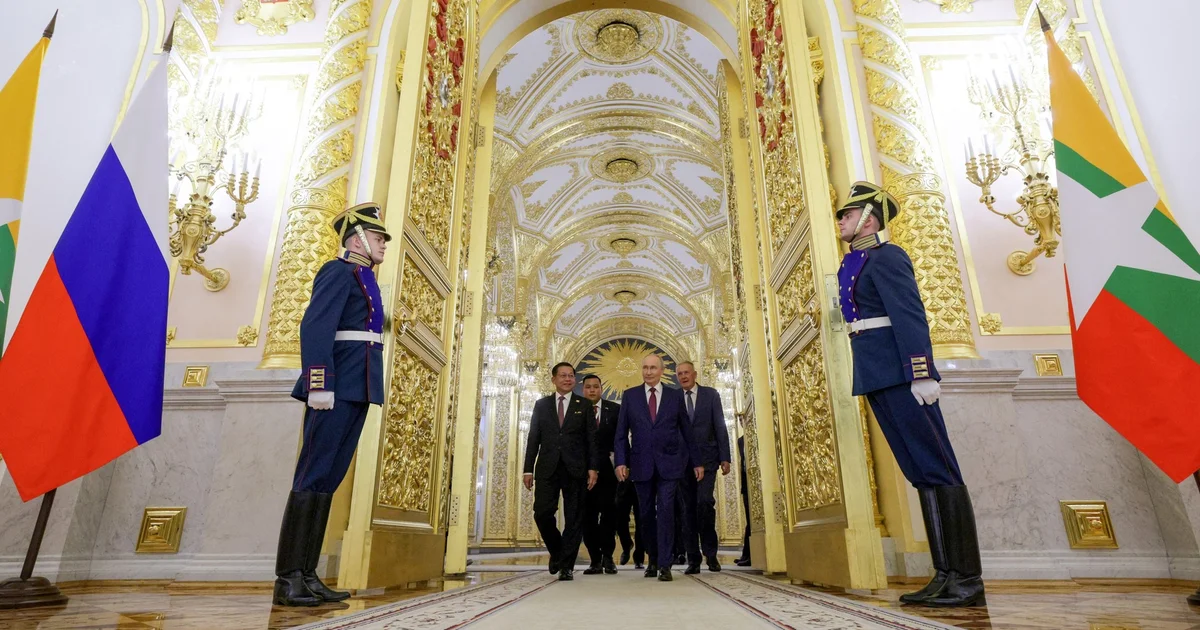
When Myanmar’s military coup leader and now “civilian” president Min Aung Hlaing met Russia’s Vladimir Putin (Opens in new window) in Moscow on 18 August, the two leaders signed a joint statement against Western sanctions along with other instruments (Opens in new window) coveringa variety of areas including energy, space, digital technology and nuclear power.
Min Aung Hlaing has visited (Opens in new window) Russia more than a dozen times. Putin has never made the return journey, which indicates the asymmetry in the relationship. Nevertheless, while Russia has been Myanmar’s arms dealer (Opens in new window)for much of the last two decades, it is now becoming much more central to the Myanmar state.
The clearest example occurred a few days before the Moscow visit. The NGO Justice for Myanmar (Opens in new window)reported that on 12 August the regime contracted Astra Group – a Russian software firm with documented links to Russian military and intelligence agencies, and sanctioned by the US and Canada – to build Myanmar’s National Single Window, the online portal through which every import and export document in the country would pass.
This integration into Myanmar’s state administration is a very different type of engagement than from supplying military hardware. If Myanmar’s system was then connected to the ASEAN Single Window (Opens in new window), as it is designed to be, a Russian company would gain an insider view into regional trade flows.
The military relationship between the two authoritarian states has also crossed a new threshold. In July, Russian and Myanmar troops held Tiger-2026 (Opens in new window) in Naypyidaw, the first joint army exercise the two countries have conducted. Previous cooperation was naval and largely ceremonial, including Marumex drills (Opens in new window) in the Andaman Sea and port calls at Thilawa.
Tiger-2026 marked a new style of engagement. Over 12 days the two armies worked through drone reconnaissance (Opens in new window) and FPV strikes, sniper employment, jungle warfare and combat engineering, with an explicit exchange of “battlefield experience”. For Myanmar, this is not preparation for a war between states. It is counter-insurgency training for a military that bombs its own population.
Tiger-2026 is best understood as an export of the Ukraine war. The tactics employed – massed FPV strikes, drone-cued targeting, assault infantry pushed forward in waves – are those Russia has refined in Donbas.









Leave a comment