


Australia’s declared strategy of denial needs to become effective long before the powerful new nuclear submarines become meaningfully effective in the 2040s.
This can be done in the 2030s with what I have called the Joint Architecture for Forward Denial. The concept, set out in full in a separate study, would comprise an independent Australian targeting network, massed ground-based long-range strike weapons and resilient northern operating bases.
The idea stems from two changes in warfare. First, surface ships can no longer hide on the oceans. Growing numbers of synthetic-aperture radar and passive electromagnetic-sensing satellites in low orbit pass over the world’s oceans quite often enough to detect ships. Second, long-range precision strike is becoming much cheaper.
The result is that ships can be easily found and cheaply attacked – attacked, in fact, by rounds that are often cheaper and more numerous than the missiles ships would use to try to stop them. This gives a middle power such as Australia a much stronger option for maritime denial than it has ever had.
These military-technical changes, however, also expose our operating bases. Northern Australian airfields, ports, fuel depots and command facilities are easily observable and within reach of China’s increasingly long-range weapons. A denial strategy, therefore, needs a system which can find, target and strike and which is dispersed and hardened enough to survive.
None of this has to wait. Satellites and ground-based strike weapons can be made operational and bases can be hardened long before the Royal Australian Navy will commission and master the use of enough nuclear attack submarines (SSNs) to seriously worry China, something that’s not likely before 2040. The interval from go-ahead to operational capability of the architecture I propose could be less than 10 years if focus and funding were sufficient. This matches the timeline of the threat, which could be severe in the 2030s.
The proposal has two main elements. The first is a Joint Sovereign Targeting Network. Probably incorporating the data-sharing system envisaged under project Air 6500, it would fuse data from new Australian-owned radar and electromagnetic-intelligence satellites, the ground-based over-the-horizon radars of the Jindalee Operational Radar Network, and the radars and passive sensors of Wedgetail surveillance aircraft. Its purpose would not be simply maritime awareness; it would provide continuous data that is precise enough for guiding weapons.
That distinction matters. A commercial satellite can tell a government where a ship was hours ago; it cannot tell missiles where that ship is now. A targeting network must hold a track (probably fusing several sensors), pass it to an Australian shooter, and keep updating the weapons in flight as the target moves.
In the proposal, the network is also the common layer that allows army, navy and air force weapons to act on the same picture. It would significantly increase the value of nuclear submarines as they are fielded, and hypersonic weapons, too.
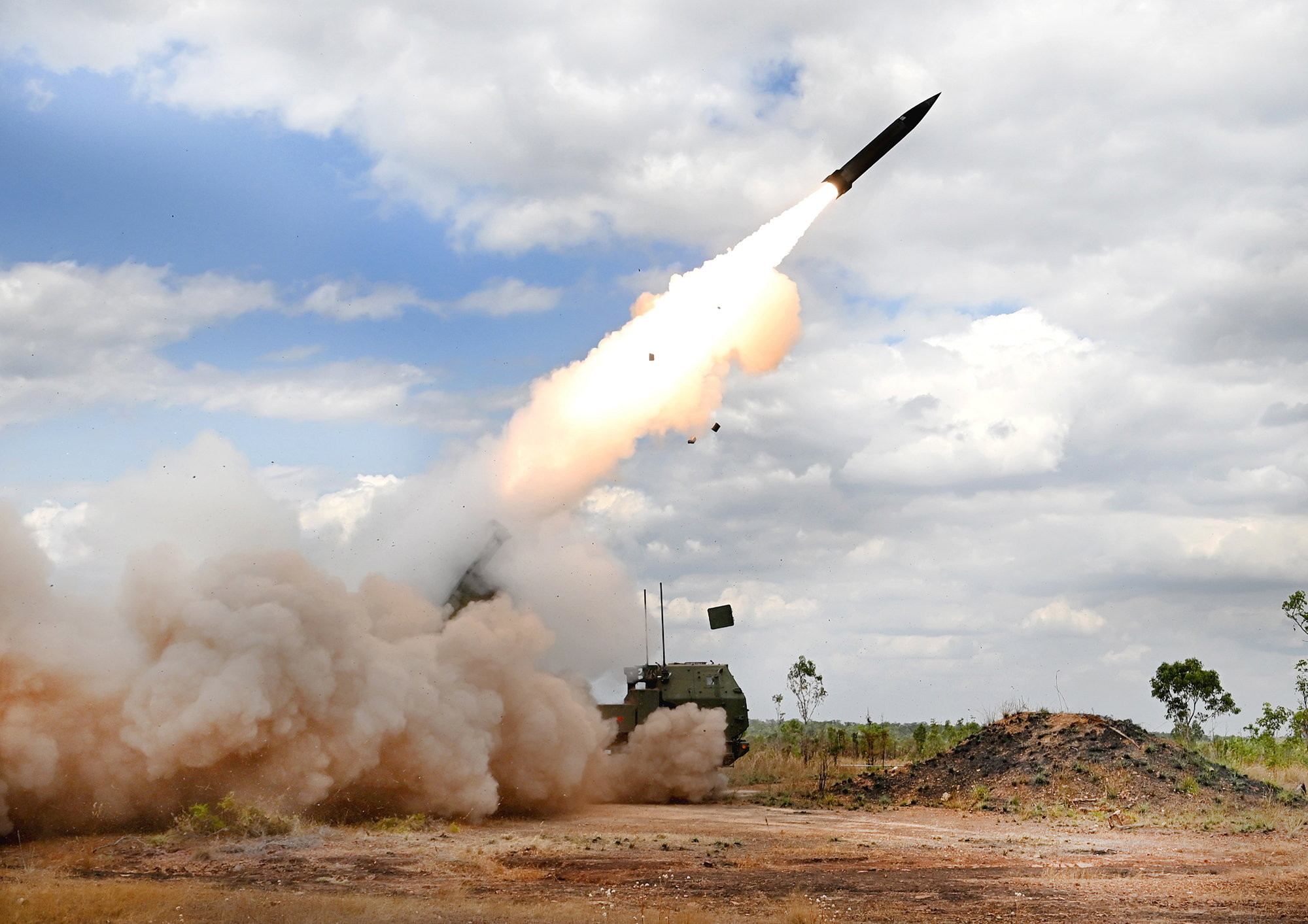
The second main element is a land-based Long-Range Precision Fires force. The design study assumes a 2,400 km strike range, chosen to cover Australia’s northern approaches from dispersed sites on Australian territory. It proposes 25 batteries together holding 3,600 containerised cruise missiles, with 20 batteries forward and five in reserve. The munition is modelled at about US$300,000 (A$421,000) per round, with a 250 kg warhead and passive machine-vision terminal guidance.
Those figures are not measurements of an existing weapon. The technical study presents them as engineering and planning estimates. The point is the force design: a round must be cheap enough to be bought in thousands to overwhelm enemy defences. This makes the factories as important as the stockpile. The plan requires an Australian-controlled production line capable of surging to replenish missile stocks, avoiding dependence on foreign supply chains and permissions to resupply.
The proposal also includes the less glamorous parts that make the concept credible: ground-based air and missile defence, base hardening, deception, dispersal and decoys. These would protect the system against the same economical reconnaissance-strike capacity that Australia would use against an approaching force.
The system is designed to be distributed and resilient. Losing satellites, ground stations or a launch battery would slow it, not stop it. The force would keep fighting.
Sequencing is key. Build the self-reliant targeting network first, and place orders to field the massed ground-based strike forces as it becomes operational while hardening and defending the northern bases. And get all this done inside the 2030s risk window. When the SSNs arrive, they would enter a theatre already watched by an Australian targeting network and already defended by a deep land-based munitions stock.
That makes the Joint Architecture best as an early deterrent force that would then stand alongside and support the SSNs.
The debate should focus less on whether any one proposed missile or satellite is exactly right and more on whether Australia has the self-reliant sensing, munitions stocks, production capacity and resilient basing needed to make denial real in the decade ahead.















Leave a comment