



Australia’s strategic thinking, increasingly focused on deterrence, has yet to distinguish the conditions that make deterrence effective from the framework through which Australia intends to implement it. Elements of both are evident in Australia’s National Defence Strategy, but their relationship is not yet clearly stated.
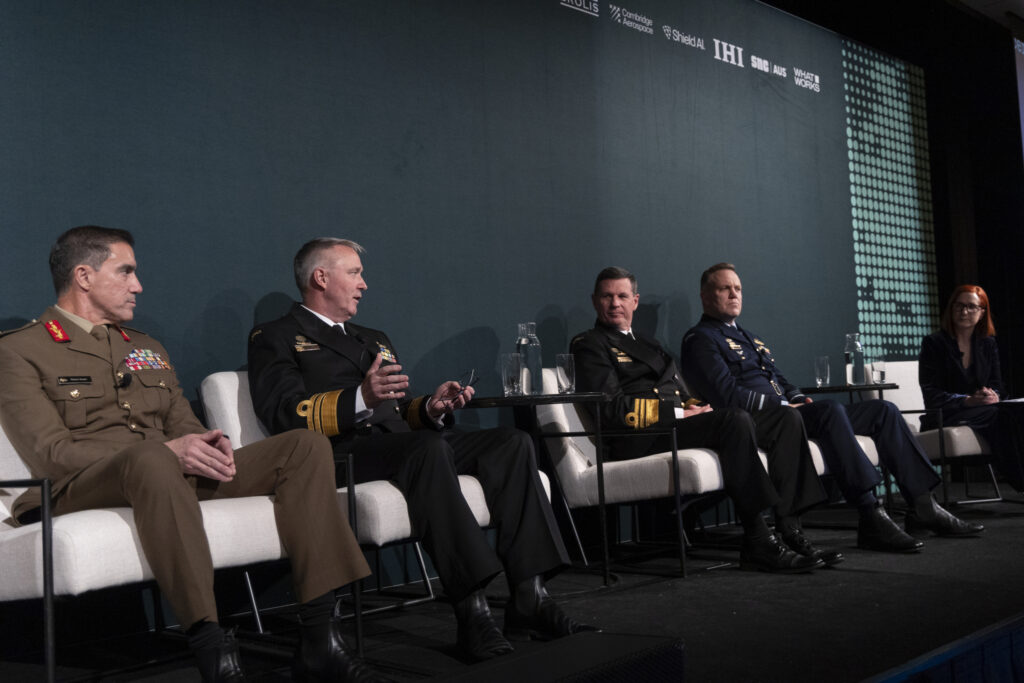
Through public discussion, an implementation approach is emerging, most recently at the June 2026 ASPI Defence Conference during a deterrence session with Australia’s service chiefs and chief of joint operations. During the panel, Chief of Air Force Air Marshal Stephen Chappell described an evolving ‘framework for deterrence’ comprising six Cs – capability, credibility, communication, comprehension, collective and cumulative – underpinned by four Ds – disrupt, degrade, destroy and defeat.
While a 6C-4D deterrence framework is memorable, many of the words in it are already established in deterrence doctrinal use in the US, Britain and NATO, and these allies and partners do not group them as a single construct because they address fundamentally different functions of deterrence implementation. The distinction matters for more than conceptual neatness. Without it, those responsible for translating deterrence into strategy, force design, capability development and operational planning are left with a framework that does not clearly distinguish the conditions they are seeking to create from the ways Australia intends to create them, or the military effects that contribute to the desired outcome. It also risks creating unnecessary conceptual divergence from Australia’s closest allies and partners at precisely the time its defence strategy increasingly depends on collective deterrence.
Capability, credibility and communication describe the conditions for effective deterrence: the elements that must shape an adversary’s decision-making. Those three Cs have long featured in US deterrence doctrine, while British thinking adds ‘comprehension’ as the foundation upon which the other three are built. NATO similarly places capability, credibility and communication at the heart of its approach to deterrence, dating back to its 2016 review. What unites these concepts is their function. Together, they establish whether an adversary perceives that a state has the capability and resolve to act, understands what is being signalled, and decides whether to adjust its calculations.
Collective and cumulative perform a different role; they are implementation principles for how Australia intends to generate and sustain the conditions of effective deterrence. Chappell’s explanation at the ASPI Defence Conference makes this distinction clearer: Australia must pursue deterrence ‘collective, as the integrated force, the five domains, three services, through joint operations with interagency, allies and partners’, and ‘cumulatively, all the time, over and over again’. At the Air and Space Power Conference 2026, Chappell further explained cumulative as signalling capability and capacity over time by ‘demonstrating through training, exercises and operations that if called upon, we can generate and deliver highly effective airpower with enhanced lethality and survivability.’ Both principles – collective and cumulative – are important, but neither explains why an adversary is deterred; they explain how Australia intends to implement deterrence.
This distinction is fundamental because deterrence is ultimately psychological, and grouping all six Cs together risks making the framework harder to translate into effective implementation. Capability, credibility, communication and comprehension describe the essential attributes and conditions of effective deterrence; collective and cumulative answer how Australia seeks to generate and sustain those conditions. Australia can generate the conditions for deterrence, but whether they actually deter is determined by their influence and effect on the adversary’s decision-making.
The four Ds address a third analytical component of deterrence: the military power that can be brought in support of deterrence effects. The capability and capacity to disrupt, degrade, destroy and defeat – those describe military effects, not deterrent outcomes. For deterrence by denial, those effects matter insofar as they convince an adversary that it cannot achieve its objectives and will be denied, either strategically, operationally or tactically. The distinction is important: the four Ds describe what military power can do; denial describes what those effects seek to prevent; deterrence describes the decision they seek to shape and influence to preserve the status quo. This analytic clarity is critical for future implementation of a deterrence framework.
While a 6C-4D deterrence framework creates a single memorable construct, the individual elements, principles and effects would benefit from an architecture that clarifies the three analytical layers that distinguish their functions. Capability, credibility, communication and comprehension serve as the conditions that make deterrence effective; collective and cumulative provide distinctly Australian principles for how those conditions are generated and sustained; and disrupt, degrade, destroy and defeat describe the employment of military power to generate the effects required to deny an adversary its objectives. Once the layers are separated, the framework more clearly translates the National Defence Strategy’s deterrence ambition into implementable, practical application for strategists, force and operational planners and capability developers.
Deterrence is an imprecise concept, and denial lacks universal agreement – and the same goes for collective deterrence. As Australia further develops its framework, it should harmonise the 6C and 4D definitions and functions with the allies and partners to ensure conceptual interoperability and integration. Divergence would ultimately create unnecessary analytical incoherence and complexity in a domain where common conception is fundamental to delivering combined planning, exercising and operations. As Chief of the Defence Force Vice Admiral Mark Hammond said at the ASPI Defence Conference, Australia does not want ‘to contemplate a strategy of deterrence on our own…’ If Australia does not intend to deter alone, the framework through which it implements deterrence must enable Australia to think, plan and act collectively with its allies and partners.
















Leave a comment