


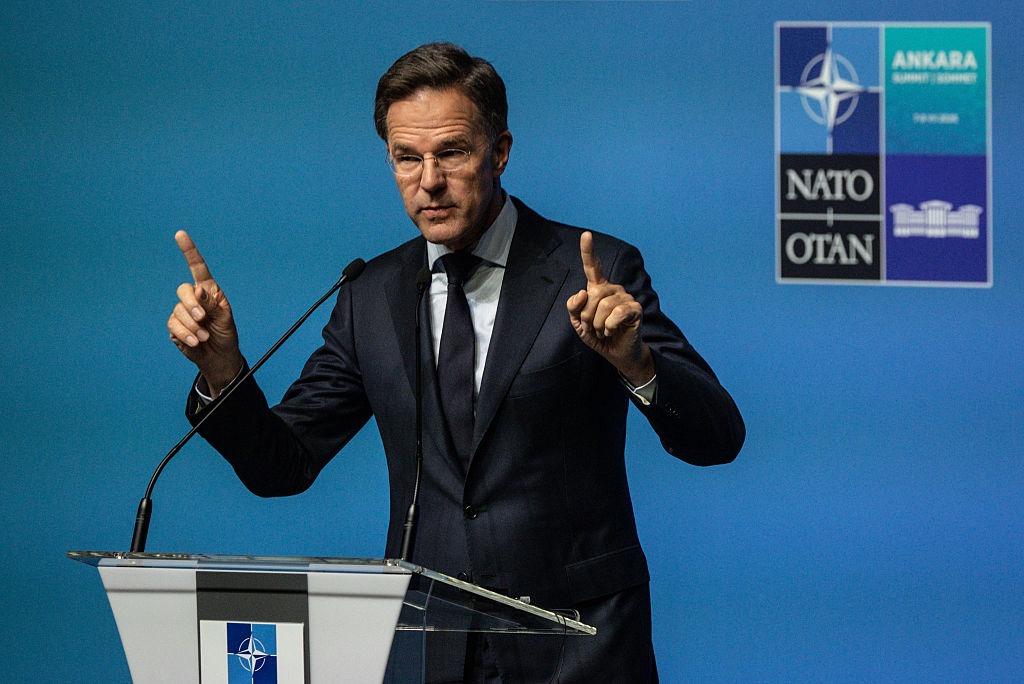
On 5 August, the Indo-Pacific and Euro-Atlantic Hub for Shared Security Challenges met to assess what happened at NATO’s Ankara summit in July. The hub, which was launched in February, is a regional network open to think tanks and universities from NATO countries and NATO’s four Indo-Pacific (IP4) partners: Australia, Japan, New Zealand and South Korea.
A view from NATO
Ambassador Kevin Hamilton, NATO deputy assistant secretary general for partnerships, NATO Headquarters
As Boris Ruge, a former NATO assistant secretary general, noted at the launch meeting of the hub last February, cooperation between NATO and its IP4 partners is not new.
NATO and several of its Indo-Pacific partners worked side by side in the International Security Assistance Force in Afghanistan and in the Western Balkans, helping post-conflict countries to stabilise and rebuild.
Russia’s war of aggression against Ukraine marked a turning point and an imperative to deepen our cooperation. The war is a stark reminder that global challenges require global cooperation, but also of how closely the Euro-Atlantic and Indo-Pacific are connected.
Strengthening NATO’s industrial base has become a key area for cooperation, as indicated in the Ankara Summit Declaration. NATO is increasingly seeking to leverage its partnerships to maximise defence industrial cooperation.
The main message of the Ankara summit, as underlined by Secretary General Mark Rutte, is clear: NATO is delivering. Defence investments continue to increase, new capabilities are being delivered, industry is expanding production, and European Allies and Canada are taking greater responsibility for our shared security. This is what NATO 3.0 means: a stronger Europe in a stronger NATO.
NATO’s partnership with the IP4 does not mean that NATO has expanded into the Indo-Pacific. NATO is and will remain a transatlantic alliance. Our objective remains collective defence and the security of the Euro-Atlantic region. But we recognise that the security of our two regions is interconnected.
This is why the Indo-Pacific and Euro-Atlantic Hub for Shared Security Challenges is so important. Through research, meaningful conversations and by debunking myths about NATO and its partnerships, we can strengthen mutual understanding, create opportunities for exchange and actively strengthen the resilience of our democracies.
A view from Australia
Stephan Fruehling, Strategic and Defence Studies Centre, Australian National University
Increasing European defence investment, new platforms for engaging industry and the fact that there was no open break between US and allied leaders in Ankara are all welcome outcomes for Australia. But in general, the political and practical importance of the last NATO summits in Ankara and The Hague was less for Australia than earlier ones, given the much shorter political discussions and NATO’s focus on internal transformation.
It is worth considering what has driven Australia’s engagement at NATO summits since the first formal partnership 20 years ago:
- First, access to political discussions on operations in which Australia participates or might participate – an interest that is in abeyance until NATO moves back into out-of-area missions.
- Second, broader Australian access to NATO’s more technical activities since it was first given access to some Partnership for Peace activities two decades ago – a goal that’s now mostly a question of further increasing familiarity at the working level than removing political barriers.
- Third, strategic dialogue with Euro-Atlantic allies, especially on the rise of China and links between Euro-Atlantic and Indo-Pacific theatres. This hasn’t gone away, but the high point of NATO summits engaging with these issues was during 2022 at the Madrid summit with the development of the 2022 Strategic Concept.
- Fourth, and more recently, NATO’s role as a platform and forum for defence industry cooperation and supply-chain coordination, including through NATO’s Conference of National Armaments Directors.
This last point is the remaining focus, and hence it is no surprise that it was Defence Industry Minister Pat Conroy who represented Australia in Ankara.
A view from Japan
Akira Igata, Research Center for Advanced Science and Technology, University of Tokyo
For Japan, the Ankara summit was not a watershed moment that fundamentally transformed its relationship with NATO. However, it served an important purpose by reconfirming the direction in which the relationship is already moving. The analysis that the Euro-Atlantic and Indo-Pacific security environments are interconnected has become something of a truism among NATO and its IP4 partners. All parties share the will to pursue further cooperation in areas of mutual interest, and many, if not most, countries also agree on what those areas are. This broad agreement was confirmed by the participation of senior government representatives, sending a political signal that will allow the relevant bureaucracies to move NATO-Japan cooperation further towards practical implementation.
Defence-industrial cooperation is one of the most promising areas for such progress. Ministerial participation in Ankara, including Japan’s first attendance at the NATO Defence Industry Forum, gave political backing to closer cooperation in this field. This aligns with Japan’s security policy revision and its efforts to strengthen its domestic defence-industrial base, enabling Japan to assume greater responsibility for sustaining deterrence and contributing to international stability.
In short, the Ankara summit laid the groundwork. The task now is to translate political agreement into tangible action.
A view from New Zealand
Serena Kelly, New Zealand Institute of International Affairs
I’m sure no one needs reminding that New Zealand is a remote, geographically isolated, small state. This makes attending the NATO summit of utmost importance for building and strengthening New Zealand’s international relationships. It provides an opportunity to cement and build our relations with like-minded countries and to engage in discussions that might help shape the future world order.
New Zealand’s foreign policy has traditionally been driven by an identity that is both independent and nuclear free. Some argue that can be partly attributed to our distance from global hotspots. As a result, New Zealand’s commitment to defence spending is historically less than in the other hubs (South Korea, Japan, and Australia). Yet, in 2025 then defence minister Judith Collins announced an increase in defence spending by 12 billion dollars over four years.
Changes in defence spending rely on public support. Consistent messaging and communication can help build this. Positive and consistent messaging, both internationally and from the New Zealand Government, surrounding the Ankara summit should help to foster favourable public sentiment towards increased defence spending.
Additionally, the summit’s Defence Industry Forum was also highly valuable for New Zealand. Not only did it offer an opportunity to showcase companies such as Starboard and Syos Aerospace, but it also offered a chance to learn from international partners and industry leaders.
A view from South Korea
Euichan Shin, Dongduk Women’s University
From South Korea’s perspective, the Ankara summit highlighted the importance of cooperation with NATO in defence industry, procurement and innovation. The central question is no longer whether Euro-Atlantic and Indo-Pacific security are connected, but how South Korea and NATO can turn that understanding into institutional cooperation.
President Lee Jae Myung’s proposal for a Korea–NATO Defence Industry Partnership 2.0 reflects this shift. It seeks to move beyond arms sales towards joint research, production and operation of defence systems. Negotiations on a procurement framework agreement, together with South Korea’s participation in NATO’s Science and Technology Organization through the Science and Technology Enhanced Partnership, could provide a basis for such cooperation. South Korea’s association with Pillar Two of Horizon Europe also strengthens research links with Europe in artificial intelligence, cybersecurity, space and advanced materials. Although separate from NATO, these areas have dual-use relevance and demonstrate capabilities South Korea can bring to the partnership.
This cooperation has become more urgent as North Korea supplies troops and weapons to Russia, raising concerns that military technology and operational experience could flow back to the Korean Peninsula. The next step is to develop common standards, expand testing and certification, support collaborative research and create pathways for Korean firms to participate in NATO-related procurement and supply chains.
A view from Germany
Aylin Matle, Center for Security and Defense, German Council on Foreign Relations
On Russia, NATO’s Ankara summit was clear-eyed: the summit declaration named it far more explicitly as a long-term threat than the previous document in 2025 did, leaving no doubt about the alliance’s immediate priority. For Germany, that cements former chancellor Olaf Scholz’s Zeitenwende speech as the permanent baseline for defence planning.
China is a different story. The summit declaration did not mention it directly; instead reference to Beijing was couched in ‘strategic competition’ language. That vagueness leaves one important question regarding coordination between the Euro-Atlantic and Indo-Pacific unanswered: what, concretely, if anything at all, are allies willing to do about China?
Without clarity on substance, coordination between NATO and the IP4 partners carries the risk of petering out and remaining rather symbolic: photo opportunities and side meetings rather than further joint planning on how to deal with China’s rise. The most likely trajectory is of a technical rather than political-strategic nature: defence-industrial cooperation, interoperability and supply-chain resilience. Those are areas in which cooperation could achieve concrete gains without forcing allies into a formal position on China. For Germany, that’s a manageable entry point, but a genuine dilemma remains over deeper engagement with the Indo-Pacific, given resources already stretched by Russia and Ukraine.
About the hub
The Indo-Pacific and Euro-Atlantic Hub for Shared Security Challenges is a virtual network connecting more than 40 think tanks and academic institutions from NATO Allies and IP4 partners interested in enhancing understanding of common challenges between the two regions. The initiative is supported by a public engagement grant from NATO Headquarters and it is open to relevant stakeholders from the two regions.
Interested parties can contact Pietro De Matteis, engagement officer for the Indo-Pacific at NATO Headquarters and follow the hub on LinkedIn.









Leave a comment