


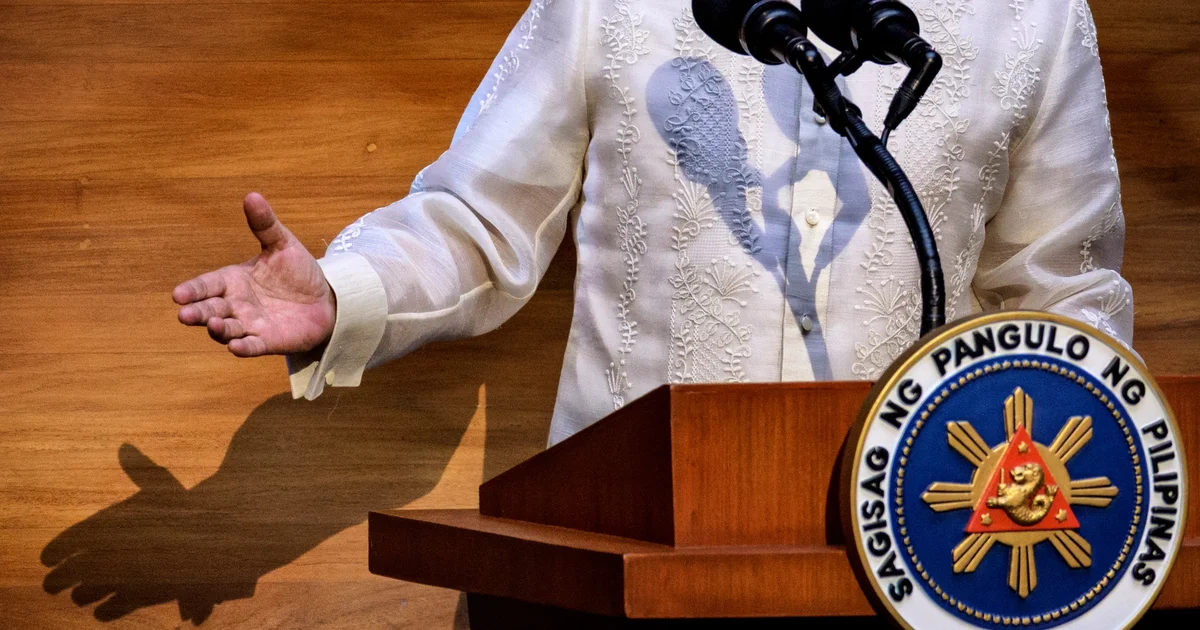
This presents the US with an opening to build an alliance that can better withstand political turnover. The goal should not be to lock Manila into permanent alignment with Washington, but to ensure that continued cooperation serves Philippine national interests regardless of who holds the presidency.
While the Mutual Defence Treaty between the Philippines and the United States provides a legal foundation for the alliance, it does not guarantee continuity in Manila’s broader China policy. This vulnerability was evident in Duterte’s 2020 attempt (Opens in new window) to terminate the Visiting Forces Agreement. An earlier CSIS report (Opens in new window) from 2015, anticipating leadership changes in both countries at the time, highlighted the need to institutionalise the alliance so it could withstand such changes. Much of this institutionalisation has since occurred (Opens in new window) under the Marcos Jr. government – but not entirely.
Trade also continues to complicate Manila’s calculus. According to the Philippine Statistics Authority (Opens in new window), the US was the Philippines’ largest export market in June, while China supplied nearly a third of its imports. These divergent economic ties give Manila a stake in maintaining relations with both powers; the Duterte government clearly demonstrated attempts to maintain this balancing act (Opens in new window).
The challenge for the US, then, is to build resilience beyond the preferences of a sitting government. Analysis of US alliances in Asia (Opens in new window) suggests that institutionalisation can help alliances withstand political change, while the transition from Duterte to Marcos demonstrates how changes in leadership can significantly alter US basing access and security cooperation. Deeper military, economic, and people-to-people ties can anchor the alliance across Philippine institutions and society.
A 2025 ISEAS study (Opens in new window) found that US military facilities associated with the Enhanced Defence Cooperation Agreement (EDCA), signed by the countries in 2014, have complicated the ability of local governments to move away from the foreign and security policies adopted under Marcos. It found that some local officials were concerned about being drawn into a US–China conflict and questioned the accountability of the US military, while local governments in Cagayan and Palawan reported limited consultation over the establishment of EDCA sites. This raises questions about democratic choice, but also points to a way forward. Institutionalising the US–Philippine alliance should not prevent a future government from changing course; its durability could be better grounded in domestic support.
A 2025 Social Weather Stations survey (Opens in new window) gave the US a +63 net trust rating, while a 2025 ISEAS survey (Opens in new window) found 86.4% of Philippine respondents supported aligning with the United States, the highest share among the countries surveyed. This suggests that the alliance has support that Washington can build on beyond the current administration. The US–Japan alliance offers a promising precedent (Opens in new window): despite periodic opposition to the US military presence, support among the Japanese public for the security relationship has remained high.
Relationships beyond the national executive, particularly with Philippine institutions and local governments, can help anchor the alliance through changes in foreign policy. The experience of US–China competition in Cagayan and Palawan (Opens in new window) illustrates how local political and economic actors can shape the reception of US and Chinese engagement. Recognising that presidential influence operates alongside these actors (Opens in new window) can help Washington better understand the domestic political dynamics that will shape the alliance beyond Marcos.
Institutionalisation can make abrupt reversals less likely by giving the relationship deeper institutional and societal foundations (Opens in new window). Alliance-building must accommodate domestic choice, using existing public support to deepen cooperation without locking future governments into a particular course. For the US, the aim should not be to preserve one Philippine administration’s policy, but to build an alliance valuable enough to endure the next.








Leave a comment